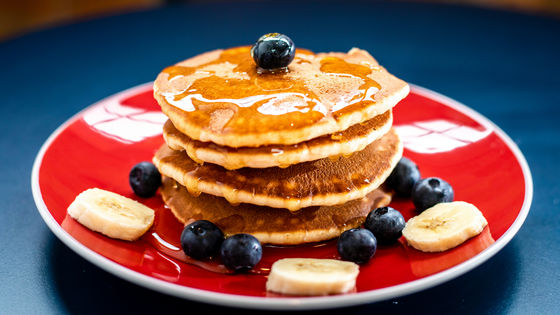
A pancake recipe optimized to the extreme based on chemistry.
The Absurdly Optimized Pancake: Leaving Chemistry, Acid-Base Stoichiometry, and an Interactive Calculator | Absurdly Optimized
https://www.absurdlyoptimized.com/recipes/pancakes/
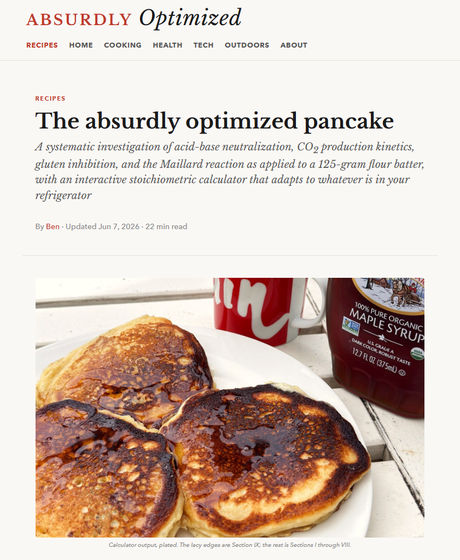
Ben has been making pancakes for 25 years, and he says that pancakes were 'the first dish he ever learned to cook.' Initially, he faithfully followed the recipe in the cookbook ' Pancakes: From Morning to Midnight ' for nearly 20 years, but after discovering J. Kenji Lopez Alto 's buttermilk pancake recipe, he says he has been faithfully recreating that recipe ever since.
However, she was dissatisfied with the buttermilk pancake recipe because it required the use of buttermilk, which is not a very common ingredient, and because the recipe specified inaccurate measurements using cups rather than weights.
So Ben has devised a 'pancake recipe optimized to the extreme,' starting from the fundamental principles of pancakes. According to Ben, there are four important elements to the quality of a pancake: 'internal texture,' 'sourness,' 'fluffiness and structure,' and 'crispy exterior.'
The characteristics of each are as follows:
- Texture of the inside
Ben insists that the inside of a pancake should be light and have a custard-like texture, and that a heavy, bread-like texture is out of the question. The texture of the inside is determined by the leavening agent, protein, and moisture content. Ben dismisses hard pancakes, saying, 'Pancakes that you have to chew haven't fulfilled their purpose.'
·acidity
A bland pancake is like a medium that enhances the maple syrup. A delicious pancake has a unique sourness from lactic acid and citric acid that are intentionally left unneutralized, and Ben argues that this is a stoichiometric decision. He says that how much of the available acid is consumed by baking soda and how much is left untreated greatly affects the sourness.
• Swelling and structure
Ben argues that pancakes should have height rather than the thickness of a cake, and that this is influenced by 'baking powder,' 'the reaction between baking soda and acid,' 'steam generated from high-moisture ingredients,' and 'whipped egg whites.' Since these all act on different time scales, each has an effect independently.
- The outside should be crispy.
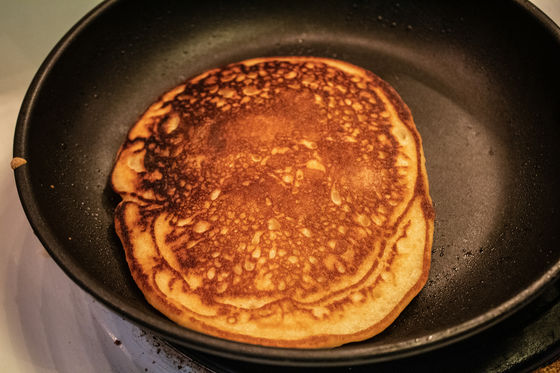
The thin Maillard reaction browns the surface, creating a textural contrast. This requires a surface temperature of over 140 degrees Celsius and the formation of a micro-fry zone where reducing sugars, amino acids, and clarified butter rapidly dehydrate the surface. The crisp texture comes not from cornstarch, but from the crust created by the Maillard reaction and the edges fried in clarified butter. Amylose is brittle and creates a glass-like shell, but if used in excess, it results in a texture more like an artificial fried coating than a pancake crust, so this recipe is designed to avoid that.
Apparently, most recipes optimize only one of these four elements, ignoring the other three. However, Ben's 'ultimately optimized pancake recipe' prioritizes all four elements to the greatest extent possible.
Ben's 'perfectly optimized pancake recipe' is as follows. This recipe makes two servings of pancakes.
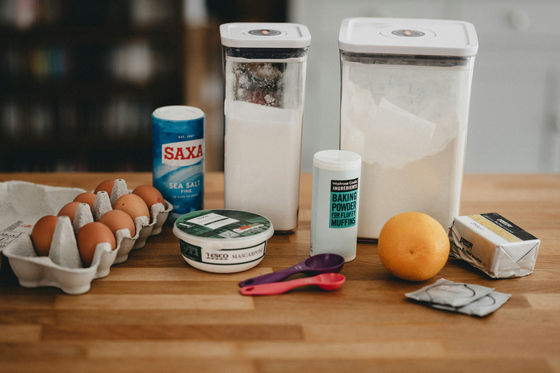
◆Materials
Wheat flour: 162g
Instant yeast: 0.49g
Sugar: 18.9g
Fat-free milk powder: 7.29g
Salt: 0.81–2.43g
Whole milk ricotta cheese: 200g
Sour cream: 50g
Kefir: 217g
Lemon: 1
Butter: 33.8g
Maple syrup: appropriate amount
Eggs (large size): 2
Vanilla extract: 4.2g
Fresh lemon juice: 17.5g
Baking powder (aluminum-free): 12.9g
Unrefined Berkshire pork fat chunks or clarified butter: appropriate amount
Blueberries (optional): approximately 126g
◆Recipe
1. Combine flour, instant yeast, sugar, non-fat milk powder, and salt in a large bowl and mix well.
2. Mix the whole milk ricotta cheese, sour cream, kefir, and lemon zest until smooth. Using an electric mixer is recommended to break up the ricotta cheese and sour cream.
3. Pour 1 into 2, and mix gently 10-12 times until everything is well combined. It's okay if there are some lumps. Once mixed, cover and leave at a cool room temperature (20 degrees Celsius) for about 10 hours. Be careful not to leave it for more than 12 hours, as it will ferment too much and become sour.
4. Melt the butter in a small frying pan or microwave, then begin preheating the frying pan. A cast iron frying pan is ideal, and the heating time is about 8-10 minutes over medium-low heat. A carbon steel frying pan can also be heated for 5-7 minutes over medium-low heat. At this time, warm the serving plate for the pancakes and the maple syrup topping in a 90-degree oven.
5. Separate the egg yolks and whites, and whisk the egg whites with a clean, dry electric mixer. Add the cream of tartar and whisk until stiff peaks form.
6. Gently mix the melted butter, egg yolk, vanilla extract, and fresh lemon juice into the mixture from step 3 by hand, mixing until everything is combined. It's okay if there are still a few lumps.
7. Once the cast iron frying pan is heated to 150 degrees Celsius, gently mix in the baking powder from step 6, sifting it over the ingredients.
8: Mix 5 (egg whites) into 7. Mix in 1/4 of the egg whites first, then gently mix in the rest. Cook as many pancake batters as possible in the frying pan at once.
9. Place chunks of unrefined Berkshire pork fat or clarified butter in a heated frying pan. Once the fat has melted and become shiny, pour in approximately 105ml of pancake batter in 13cm diameter circles. The batter will expand to a thickness of about 1.4cm while cooking. If using blueberries, scatter them at 3.9cm intervals when pouring in the batter.
10. Place the pancake batter in a covered pan and cook one side for 3.5 to 4 minutes. Cook until the surface is firm and the moisture is gone. The steam trapped inside the pan cooks the thick, fluffy inside faster than the heat coming from below. For the last minute or so, remove the lid and cook to dry the surface. This makes the surface of the batter crispy. Flip the pancake when the edges have firmed up, bubbles have burst, and the edges appear dry. Then cook for another 2 minutes with the lid off. Judge the doneness by the center of the pancake, not by the clock. If the surface is brown but the center is still moist, the heat is too high or there is too much pancake batter.
11. Place the pancakes on a warmed plate, pour warm maple syrup over them, and it's ready.
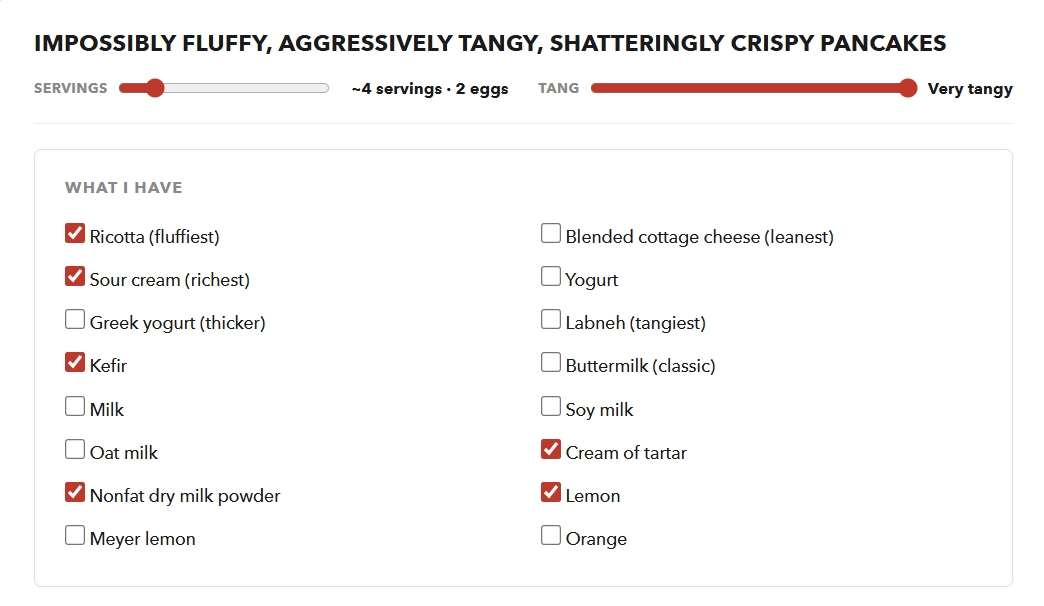
Furthermore, Ben's recipes can be slightly customized by choosing how many servings to make (SERVINGS), the level of acidity (TANG), and the ingredients to use (WHAT I HAVE). By default, whole milk ricotta cheese, sour cream, kefir, and non-fat milk powder are used as dairy ingredients, but you can substitute them with Greek yogurt, yogurt, cottage cheese, levne, buttermilk, milk, soy milk, or oat milk, so you can fine-tune the recipe to suit what you have in your refrigerator.
On the social forum Hacker News, comments included, 'The world needs more parametric recipes! This is great. I love it,' and 'It looks like Claude's output.' Ben also explains on the About page of his website Absurdly Optimized, 'This site was created with the great help of Large-Scale Language Models ( LLMs ). They assist with literature searching, writing, and computation. The approach is human.'
Related Posts:



in Food, Posted by logu_ii