Is it possible to record Mega Drive games onto analog records and play them on the actual console?

Retro gaming YouTuber
Can We Load Sega Games Off a Vinyl Record? - YouTube
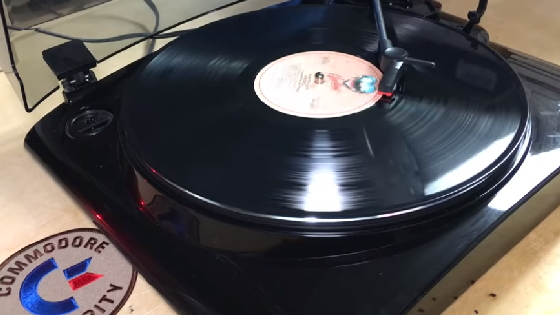
The goal is to connect the Genesis, the overseas version of the Sega Mega Drive, to a record player and test whether it can read game data recorded on a record. First, if the audio data can be restored on the game console, then it should be possible to put not only music but also game software on records.

The record player we'll be using is the '

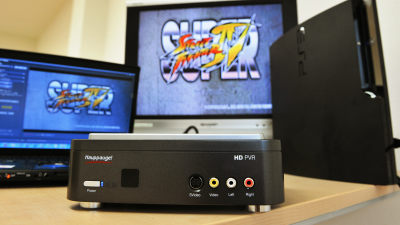
First, we started by checking the Genesis console's functionality, then connected the RGB-modified console to the capture environment. After struggling with issues such as the video being stretched horizontally or flickering, we managed to get the Mega Drive multi-cartridge '

To run custom software on the Mega EverDrive Pro, I'll put a Genesis ROM onto an SD card and perform a boot test.

Next, we create a simple test ROM using SGDK, a development environment for Genesis, and verify that it can be loaded on the actual hardware.

After researching how to handle data as sound, I discovered that saving digital data to analog audio media such as cassette tapes requires 'modulation,' which converts the bit sequence into an audio waveform, and 'demodulation,' which restores the bit sequence from the played sound.

Therefore, Mumbo created a system using a Raspberry Pi Pico 2 to transfer ROMs to the Mega EverDrive via USB. First, he confirmed that he could transfer his custom ROM from the Pico 2 to the Genesis and boot it up without using audio, thus completing the foundation for the data transfer part.

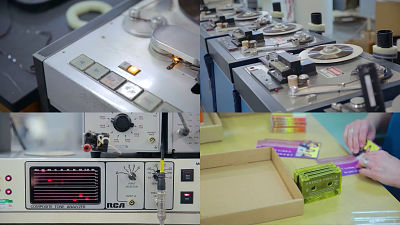
Next, we connected an audio input to a Raspberry Pi Pico 2 and conducted an experiment to read the sound played from a cassette tape as data. We succeeded in transferring the text data, and although the transfer speed was quite slow at approximately 1200 bps, or about 150 bytes per second, it demonstrated that data could be reconstructed from sound.

Next, a demo program for Genesis, compressed to reduce its size, is loaded from a cassette tape. The Raspberry Pi Pico 2 reads the playback sound, and then passes the data to Genesis via the Mega EverDrive. This displays plasma-like images and a simple demo on the screen, demonstrating that the experiment of booting a ROM from a cassette tape was successful.

Having succeeded with cassettes, they finally tried the same thing with records. However, the P0-80 record factory they purchased did not come with instructions, and they had to rely solely on a short assembly video to put together the numerous plastic parts and wires, making the experiment quite difficult.

The P0-80 record factory setup is complete. First, we'll perform a test by recording music and creating a record.

He did manage to record his own songs onto a record and play them back, but Mumbo says the playback sound is heavily distorted, with a lot of noise and skipping, making it quite unsuitable as a data storage medium.

Next, the game attempts to transfer the audio from the game data saved on the cassette to a record, and then load that record into the Genesis.

However, if the volume was too loud, the sound would distort, and if it was too quiet, it would become impossible to decode. As a result, no matter how many times they recorded records, they were unable to obtain stable data.

Although they succeeded in reading Genesis ROMs from cassette tapes, Mumbo failed to read games from records using this inexpensive record-making kit, leading him to argue that 'a higher-quality recording and playback environment is needed to make this a reality.'
Related Posts: