What is the 'radio bubble' created by the signals that Earth has sent into space so far?

Radio waves emitted from Earth are thought to travel at the speed of light, reaching the far reaches of space. Nishant, a doctoral student at
Exploring the Wonders of the Cosmos
https://www.thescientificdrop.com/2026/05/earths-radio-bubble-every-signal-weve.html
There's a concept called the 'Earth's radio bubble,' which suggests that all the radio waves humanity has ever emitted into space are spreading out in a spherical shell at the speed of light. Humanity began serious high-power wireless communication in the early 20th century, and it can be said that radio, television, radar, satellite communications, and even messages intentionally sent into space have continued to spread into outer space ever since.
Because these signals travel at the speed of light, a signal transmitted in 1936 would reach approximately 90 light-years from Earth by 2026. However, since the Milky Way galaxy is about 100,000 light-years in diameter, the radio bubble still only covers a very small region of the entire galaxy.
Mr. Nishant has created the following diagram by combining a star catalog called the ' Hipparcos Catalogue ' with Python.
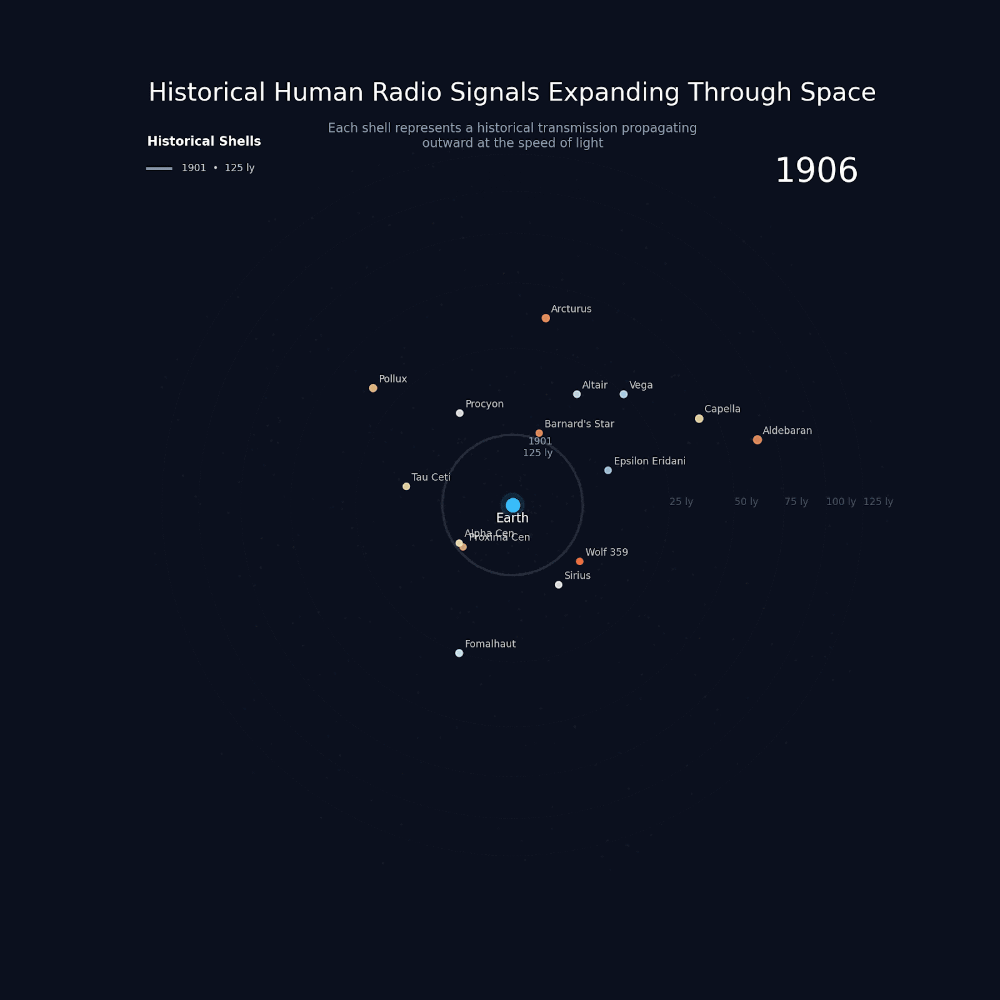
Radio waves emitted from Earth spread out in concentric circles. The outermost gray circle represents high-power radio communications from 1901, when they first began, and these radio waves reached approximately 120 light-years away. The broadcast announcing humanity's first moon landing in 1969 will reach near
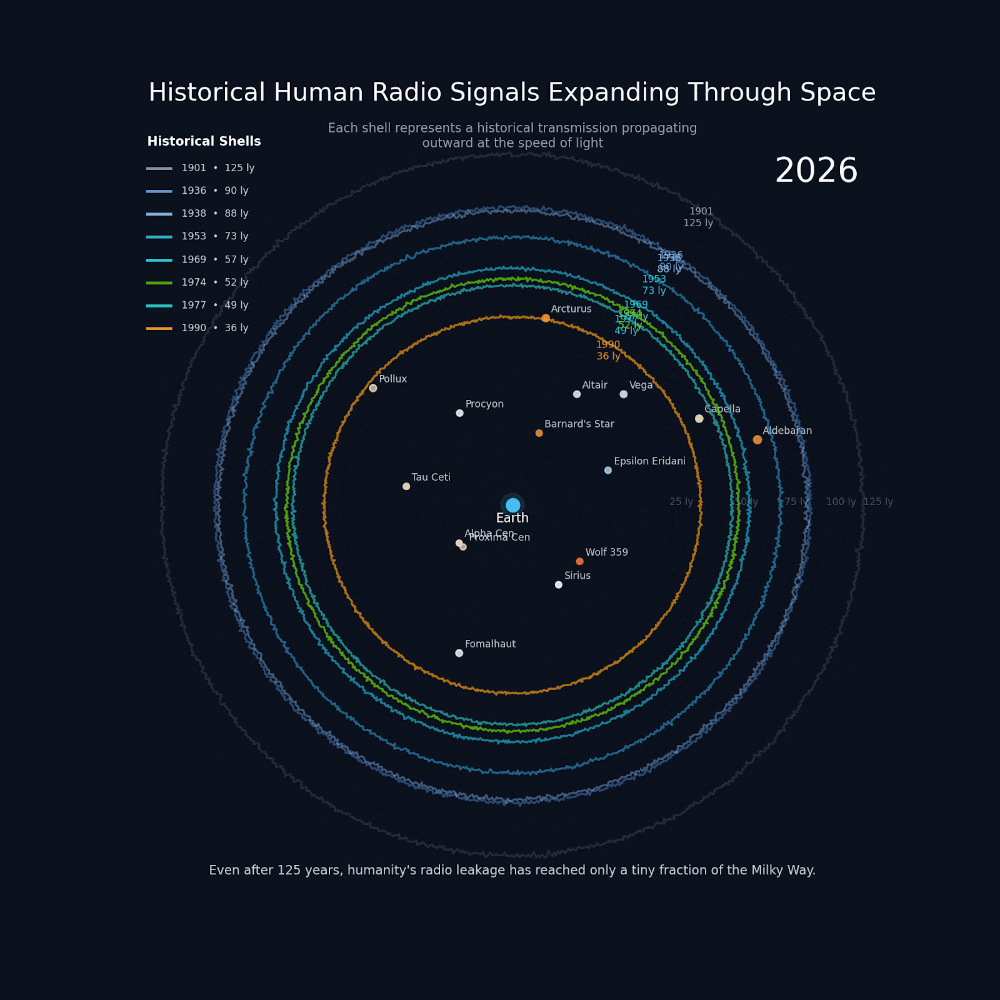
Celestial bodies within a radio bubble receive Earth's radio waves, and if there is an intelligent civilization there, it may be receiving and decoding those radio waves. In his novel ' Contact ,' science fiction writer Carl Sagan chose Vega , a first-magnitude star in the constellation Lyra, as the source of a signal from extraterrestrial life. This is because 'Vega, located 25 light-years from Earth, received Earth's first radio waves, which were emitted in 1901, around 1925, and if it had responded immediately, a message would have reached Earth around 1950.'
However, the idea that radio waves can be transmitted and received several light-years away is conceptual. In real physics, most signals follow the ' inverse square law, ' which states that 'the magnitude of the physical quantity is inversely proportional to the square of the distance from its source.' In other words, if the distance doubles, the signal weakens to a quarter of its original strength, meaning that at several light-years away, it would be too weak to be detected. A 2010 study showed that detecting radio waves leaking from Earth from a distance of one light-year would require a receiver with a diameter of approximately 900 km, far larger than any device humanity has ever built.
There is a paradox called ' Fermi's paradox ,' proposed by physicist Enrico Fermi . It raises the question of why, despite the reasonable possibility of extraterrestrial civilizations existing, we have not received any messages from them. Nishant points out that Fermi's paradox can be explained by the fact that the radio waves emitted in 1901 have only reached 120 light-years away, which is only about 0.000002% of the Milky Way galaxy, and that radio waves continue to decay according to the inverse square law.

All radio waves in the radio bubble are thought to be radio waves intended for use on Earth that accidentally leaked into space. Therefore, it is considered almost impossible to detect these radio waves in space, however, if radio waves are intentionally emitted in a narrow bandwidth, there is a realistic possibility that they could be decoded at stellar distances. In 1974, the Arecibo message , the first radio message targeted at an extrasolar object, was sent to the globular cluster M13 in the constellation Hercules , about 25,000 light-years from Earth.
In 2022, marking the 50th anniversary of the Arecibo message, a team of astrophysicists at NASA's Jet Propulsion Laboratory published a paper on an updated message, 'A Beacon in the Galaxy (BitG),' intended for intelligent life somewhere in the universe. However, BitG is still in the announcement stage regarding the construction of the message, and the technology to send the message has not yet been established, leading researchers to ask, 'Should we send the 'A Beacon in the Galaxy' message into space?'
What is 'A Beacon in the Galaxy,' the latest message intended to inform intelligent life forms that may be far away in the universe about Earth? - GIGAZINE

Related Posts:





in Science, Posted by log1e_dh