It has been discovered that bacteria grow within water droplets in fog, and that they also play a role in breaking down harmful substances in the air.

Fog is a phenomenon in which tiny water droplets formed from cooled water vapor in the air float near the ground. A research team from Arizona State University, the University of Susquehanna, and other institutions has reported that bacteria contained in fog droplets are not only floating in the air but are also growing within the droplets themselves.
Growth and formaldehyde degradation of photoheterotrophic Methylobacterium within radiation fogs | mBio
The fog is alive: Researchers discover bacteria in fog droplets clear toxins from air | ASU News
https://news.asu.edu/20260514-environment-and-sustainability-fog-alive-researchers-discover-bacteria-fog-droplets-clear
Fog Is Teeming With Life, And It May Be Doing Us a Surprising Favor : ScienceAlert
https://www.sciencealert.com/fog-is-teeming-with-life-and-it-may-be-doing-us-a-surprising-favor
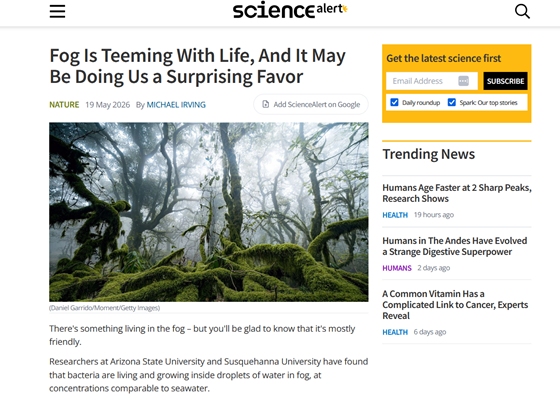
While it's known that the atmosphere contains bacteria, it's not well understood whether these bacteria are actually active in the air or clouds, or if they're simply being carried elsewhere. 'Fog is like a cloud that forms near the ground, but we knew very little about what kinds of bacteria are in it,' says Thi Thuong Thuong Cao, a microbiologist at Arizona State University.
Kao and his colleagues investigated fog 32 times over a two-year period in central Pennsylvania. The research team focused on ' radiation fog ,' which occurs when water vapor condenses as the ground cools at night, causing the air above it to cool as well. Because radiation fog tends to form in calm air with little wind, Kao and his team were able to collect air and fog water at the same location 'before the fog appeared,' 'while the fog was present,' and 'after the fog cleared.' They collected the fog water by using a fan to draw in the fog-containing air and condense the water droplets.
Analysis revealed that less than 1% of the mist droplets contained bacteria. While this may seem like a small amount, when the entire mist sample was examined together, approximately 1 million copies of DNA, a marker used to estimate bacterial levels, were detected per 1 ml of mist. Ferran Garcia-Picchel, a microbiologist at Arizona State University, explained, 'There aren't bacteria in every single droplet, but when you look at the mist as a whole, the concentration is comparable to that of seawater.'
A research team meticulously examined data from six fog-generating events and found that the amount of bacteria in the air after the fog cleared was, on average, 45% higher than in the air before the fog formed. The following microscopic images show bacteria in fine particles floating in the air during the fog (top) and bacteria in the fog water (bottom). The blue glow indicates bacteria, and the bacteria in the fog water appear larger than those in the top image. The research team considers this difference in size as one piece of evidence that bacteria are growing in the fog.
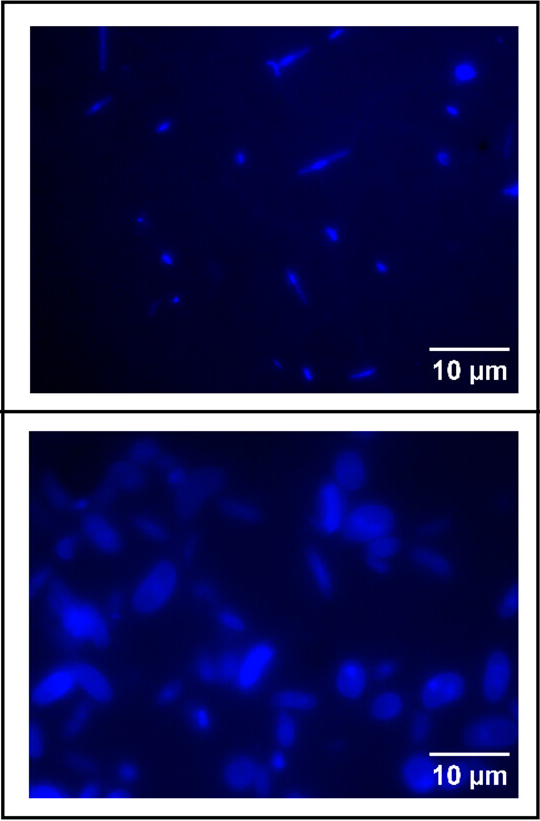
Garcia-Picchel stated, 'If bacteria are growing there, then we need to consider the mist droplets not merely as a means of transport, but as a habitat for bacteria.' Kao and his colleagues position the mist droplets not as 'places that temporarily confine bacteria,' but as 'small aquatic environments in which bacteria can thrive.'
Furthermore, genetic analysis revealed that the types of bacteria present in the mist water differed from those present in the air before and after the mist was formed. A particularly abundant group of bacteria in the mist water was the genus Methylobacterium . Methylobacterium bacteria can utilize volatile carbon compounds such as formaldehyde . Volatile carbon compounds are carbon-containing compounds that easily evaporate into the air.
The research team placed samples of mist water in the laboratory for a set period of time and measured how the concentrations of compounds such as formaldehyde changed over time. As a result, the formaldehyde present at the start of cultivation rapidly decreased to an undetectable level. This rate was approximately 200 times faster than previously measured values for cloud water.
Kao and his colleagues believe that bacteria break down formaldehyde not only for nutritional purposes, but also to process substances that are harmful to them. Formaldehyde is harmful to bacteria at high concentrations. Therefore, it appears that bacteria not only use formaldehyde as a nutrient source, but also break it down to process substances that are harmful to them.
Formaldehyde is an air pollutant that is harmful to humans. The research team suggested that bacteria in the fog may be working to reduce chemicals in the air, but explained that further research is needed to understand how beneficial this is to humans.
Kao and his colleagues believe that bacteria in the fog are involved in chemical reactions in the atmosphere, and they point out that the function of these microorganisms needs to be considered when thinking about collecting fog to use as a drinking water source.
Related Posts:





in Science, Posted by log1b_ok