A fossil dating back approximately 300 million years, previously thought to be the world's oldest octopus, has been found to be not actually an octopus.
'
Synchrotron data reveal nautiloid characters in Pohlsepia mazonensis, refuting a Palaeozoic origin for octobrachians | Proceedings B | The Royal Society
https://royalsocietypublishing.org/rspb/article/293/2068/20252369/481251/Synchrotron-data-reveal-nautiloid-characters-in
World's Oldest Known 'Octopus' Turns Out to Be An Entirely Different Animal : ScienceAlert
https://www.sciencealert.com/worlds-oldest-known-octopus-turns-out-to-be-an-entirely-different-animal
The fossil of Paulsepia masonensis, found in geological strata approximately 300 million years old, had decomposed by the time it was submerged in soft mud, making it difficult for paleontologists at the time to classify it as a species. Ultimately, the presence of eight legs, two eyes, and what appeared to be an ink sac led scientists to classify Paulsepia masonensis as an octopus. Although some scientists have raised doubts about this classification, Paulsepia masonensis has long been recognized as the world's oldest octopus.
However, in recent years, advancements in science and technology have led to the development of a technique that did not exist when Paulsepia masonensis was discovered in 2000: the ability to observe the interior of the fossil without destroying it using synchrotron radiation . Therefore, a research team led by paleontologist Thomas Clements of the University of Reading in the UK decided to re-analyze Paulsepia masonensis using synchrotron radiation.
Synchrotron radiation is light generated by using an accelerator (synchrotron) to accelerate electrons to near the speed of light and then bending their direction of travel with a powerful electromagnet. This light is far more powerful than the X-ray machines found in hospitals and can observe the inside of high-density objects without damaging them.
The following are the Paulsepia masonensis fossils that were analyzed this time.
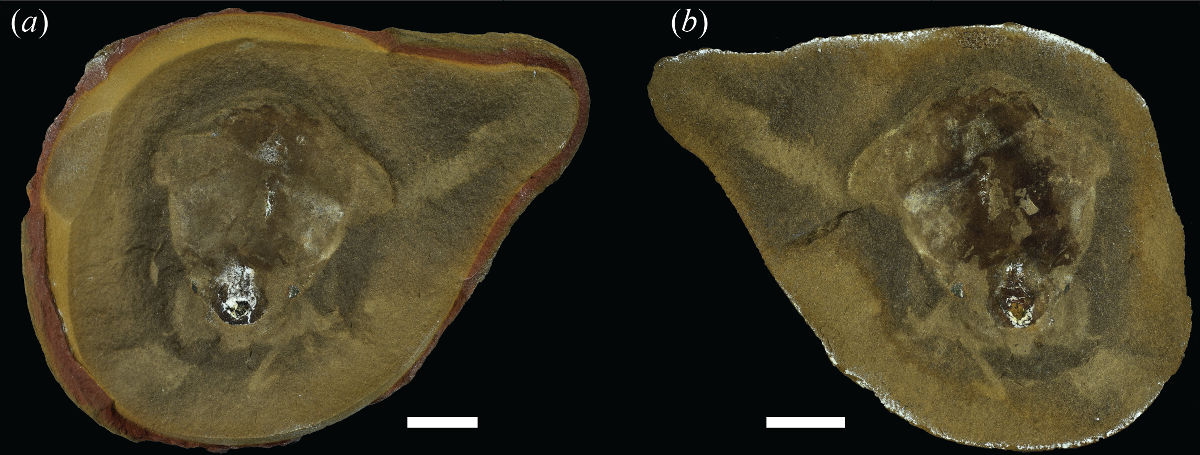
When the research team examined Paulsepia masonensis using synchrotron radiation imaging technology, they discovered a previously undiscovered anatomical feature: '11 small, tooth-like structures arranged in a row.'
This is thought to be
The part labeled 'Radula' in the following diagram is believed to be the radula, the organ discovered in this study.
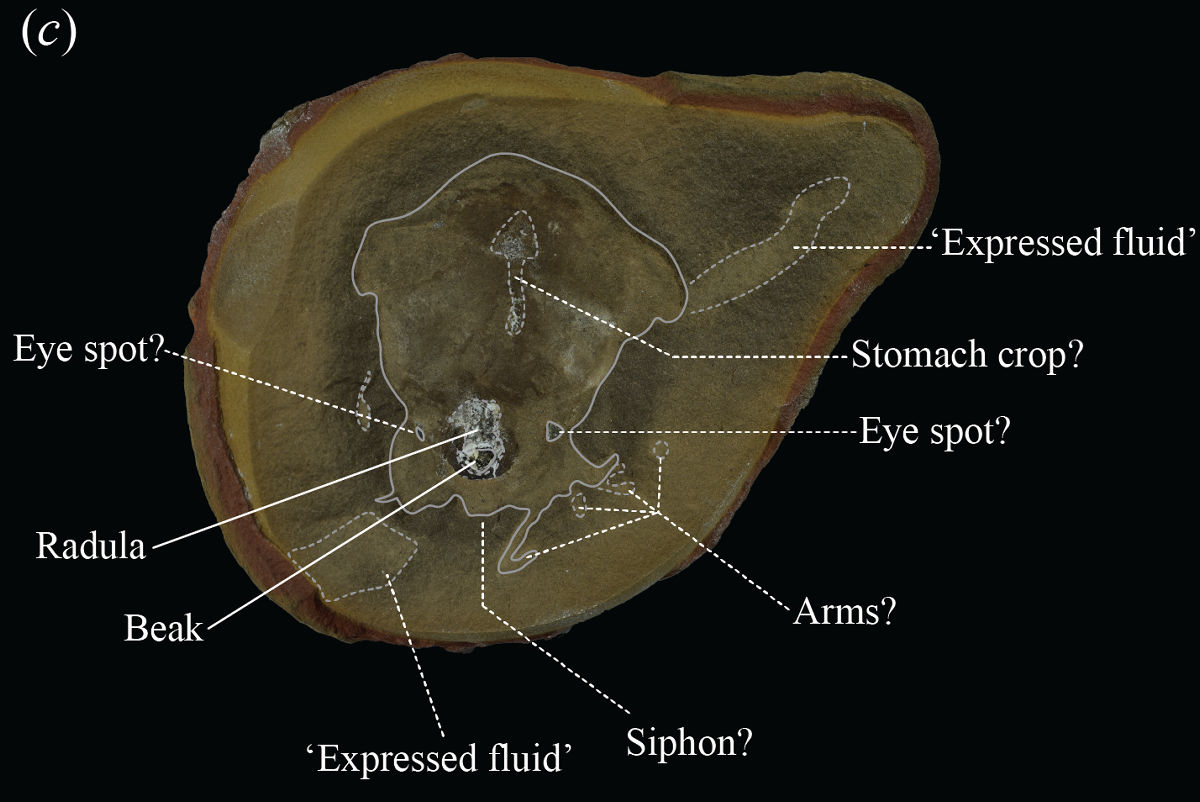
While radulae are also found in octopuses, octopus radulae generally have only 7 or 9 teeth per row, while nautiloids (nautiloids) , also in the class Cephalopoda, have 13 teeth. The radula of Paulsepia masonensis, with its 11 teeth, falls somewhere in between, but its shape has been reported to be closer to that of a nautilus than to that of an octopus.
Furthermore, no evidence has been found to support the claim that the structure previously interpreted as the ink sac of Paulsepia masonensis is actually an ink sac. While typical ink sacs are accompanied by melanosomes , which are pigments, no melanosomes were found in the organ identified as the ink sac of Paulsepia masonensis.
Furthermore, when Paulsepia masonensis was compared with other cephalopod fossils previously discovered in Maison Creek, the newly discovered radula matched that of Paleocadmus pohli, a type of nautilus. In other words, Paulsepia masonensis is not a separate species, but is actually a specimen of Paleocadmus pohli.
This research has made the 'world's oldest octopus' fossil approximately 150 million years younger. Science Alert, a science media outlet, commented, 'This is the wonder of science. Researchers in 2000 did the best they could with the information they had. And now, new technologies and methods are providing new evidence that will help us understand life on Earth more deeply.'
Clements commented, 'Sometimes, re-examining controversial fossils with new technologies can uncover tiny clues that lead to fascinating discoveries. It's amazing how a row of tiny teeth hidden in the rock for 300 million years can fundamentally change our understanding of the timing and methods of octopus evolution.'
Related Posts:


in Free Member, Science, Creature, Posted by log1h_ik