Research suggests that the human population has already exceeded the Earth's sustainable carrying capacity.
While Japan faces the problem of a declining birthrate and an aging population, many countries and regions around the world continue to experience rapid population growth, with reports indicating that the world population
Global human population has surpassed Earth's sustainable carrying capacity - IOPscience
https://iopscience.iop.org/article/10.1088/1748-9326/ae51aa
Global human population pushing Earth past breaking point – News
https://news.flinders.edu.au/blog/2026/03/30/global-population-pushing-earth-past-breaking-point/
Earth's Population Has Surpassed The Planet's Capacity, Study Suggests : ScienceAlert
https://www.sciencealert.com/earths-population-has-surpassed-the-planets-capacity-study-suggests
The carrying capacity of an environment refers to the maximum number of organisms that can continuously survive in a given environment. This is an estimate of the number of organisms that can survive long-term based on the amount of resources available in a particular environment and their regeneration rate.
Humankind, too, has a carrying capacity, but in recent years, humanity has pushed this limit by utilizing fossil fuels and other resources to overcome the problem of resource regeneration. However, as of the time of writing, the war between the United States and Iran has triggered an oil crisis, and the dangers of relying on fossil fuels are becoming increasingly recognized.
A research team led by Corey Bradshaw, a professor of geoecology at Flinders University in Australia, points out that 'today's economies are based on the assumption of uninterrupted growth and do not seem to recognize the regenerative constraints that come with sustained population growth, because fossil fuels are artificially filling the gap between population growth and resource regeneration.'
Therefore, the research team tracked changes in global and regional population size and growth rates over the past two centuries and estimated humanity's carrying capacity based on evidence. Importantly, they distinguished between 'maximum carrying capacity,' a theoretical limit that does not consider factors such as hunger or war, and 'optimal carrying capacity,' where the population can sustainably meet a minimum standard of living.
The graph below shows population trends from 1950 to 2100, with the vertical axis representing population and the horizontal axis representing years. The graph from 2023 onwards shows estimated values. Although it fluctuates depending on the scenario, the population growth rate is gradually decreasing, and it is highly likely that the population will peak between 11.7 billion and 12.4 billion in the late 2060s or early 2070s.
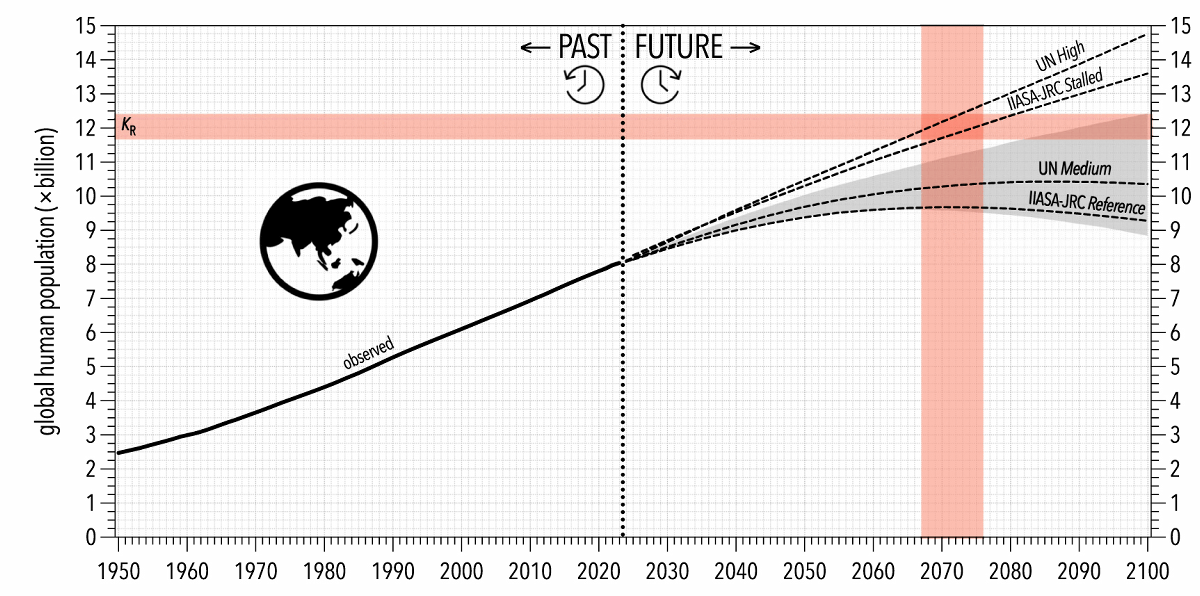
Bradshaw and his research team calculated that while the Earth's maximum carrying capacity for humanity is approximately 12 billion people, the optimal sustainable carrying capacity is only about 2.5 billion people. In other words, as of the time of writing, humanity has exceeded the optimal carrying capacity by nearly 6 billion people, surpassing the sustainable population limit.
In fact, in January 2026, the United Nations University pointed out that rivers, lakes, and groundwater are depleting at a rate exceeding their natural recovery rate, warning of a global '
Bradshaw stated, 'The Earth cannot keep up with the pace at which we use resources. Without a major change, it will not even be able to support today's demands. The Earth's life support systems have already reached their limits, and unless we rapidly change the way we use energy, land and food, billions of people will face increasing insecurity.'
It should be noted that, because numerous factors are constantly changing on Earth, it is impossible for scientists to consider all the factors that affect population, its rate of change, and the carrying capacity of the environment. Nevertheless, this study indicates that humanity needs to rethink how we use resources if we are to continue to live on Earth.
Bradshaw commented, 'A smaller population and lower consumption will result in better outcomes for both people and the planet. Time is limited, but meaningful change is still possible if countries cooperate.'
Related Posts:




in Science, Posted by log1h_ik