The argument is that measuring the 'pain' of the people reveals the wealth of a nation.

Why measuring pain could reveal more about wellbeing than GDP
https://theconversation.com/why-measuring-pain-could-reveal-more-about-wellbeing-than-gdp-279294
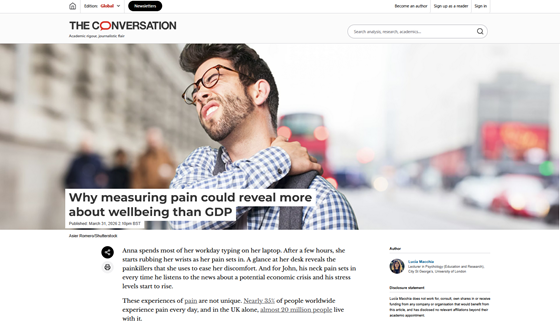
In a comment published in the academic journal Nature Human Behaviour in 2023, Macchia pointed out that pain is not solely a medical issue, but a phenomenon related to economic circumstances, social connections, and daily behaviors. He then stated that governments should include a continuous measurement of pain as an item in well-being indicators that show people's quality of life and physical and mental state.
When considering a country's wealth and quality of life, in addition to economic indicators like GDP, indicators such as how satisfied people are with their lives and how they feel have also been used. Macchia argues that one of the less visible problems that affects people's lives is physical pain.
This line of thinking is based on several studies in which Macchia himself participated. For example, in his 2022 paper, ' Pain trends and pain growth disparities, 2009-2021 ,' Macchia analyzed data from approximately 1.6 million people in 146 countries and found that the percentage of people reporting physical pain increased from 26.3% in 2009 to 32.1% in 2021. This increase was observed in both high-income and low-income countries, and was particularly large among women, low-income groups, and those with lower levels of education.
A 2021 paper, ' Physical pain, gender, and the state of the economy in 146 nations ,' showed a tendency for people to experience more physical pain in countries with higher unemployment rates. The paper stated that this trend was not limited to the unemployed themselves, but manifested as an increase in pain throughout society. The increase in pain was particularly noticeable among women.
Furthermore, the 2025 paper, ' The association between loneliness and pain, and the role of physical health and distress: an analysis in 139 countries ,' analyzed data from 2023 and 2024 of the Gallup World Poll , an international survey that examines the attitudes and living conditions of people in various countries, involving 256,760 individuals in 139 countries. The results showed that people who feel lonely are more likely to experience physical pain than those who do not. Although the strength of social connections varied from country to country, the association between loneliness and pain was confirmed in a wide range of countries.

Furthermore, in another paper published in 2025 by Macchia et al., ' Physical pain as a component of subjective wellbeing ,' pain is linked to social factors such as unemployment, low income, low education level, and economic insecurity. These factors overlap with some of the ' subjective wellbeing ' indicators that have been used to measure life satisfaction and emotional state. Nevertheless, Macchia et al. argue that 'pain cannot be adequately captured by existing wellbeing indicators alone and is worth measuring as a separate item.'
Given these circumstances, Macchia states that 'simply adding short questions to government questionnaires can significantly improve our understanding of people's lives and physical and mental well-being.' For example, by asking questions such as 'Did you experience any physical pain yesterday?' or 'How much pain are you experiencing now?', it becomes easier to identify health problems that are not easily visible through GDP or life satisfaction alone. Macchia also points out that another advantage is that these questions can be easily incorporated into existing social and health surveys.
Macchia explains that adding questions about pain to government surveys is not about replacing GDP or happiness indicators with something else, but rather about filling in the gaps that those indicators don't capture. Even if the economy is growing, if job insecurity, loneliness, and prolonged malaise are widespread, it doesn't necessarily mean that people's lives are improving. Macchia points out that by looking at the 'pain' of the people, it may be possible to see aspects of people's lives and their physical and mental well-being that are not visible through GDP alone.
Related Posts:







in Science, Posted by log1b_ok