How long does a smartphone notification disrupt your concentration?
It's a common complaint that smartphone notifications can disrupt concentration, but the actual extent of their impact and what causes this difference wasn't fully understood. Hippolyte Fournier and his colleagues, psychology researchers at the University of Lausanne in Switzerland, conducted an experiment using smartphone-like notification displays to investigate how long cognitive processing is impaired by notifications.
Push notifications as cognitive detonators? Disentangling the attentional costs of smartphone notifications via online Stroop and pupillometry
New psychology research reveals the cognitive cost of smartphone notifications
https://www.psypost.org/new-psychology-research-reveals-the-cognitive-cost-of-smartphone-notifications/
Fournier and his colleagues investigated why smartphone notifications are distracting. They divided the reasons why notifications are easily distracting into three categories: 'something suddenly appears on the screen,' 'we are accustomed to checking notifications, so we are easily distracted by anything that looks like a notification,' and 'we feel that the notification is important because it seems relevant to us.'
180 university students participated in the experiment and worked on the ' Stroop task .' The Stroop task is a task in which participants are asked to answer with the color of the word, for example, 'red,' when it is displayed in blue, rather than answering with the meaning of the word. Because it requires answering only with the color and not with the meaning, it is often used as a way to check for attentional disturbances.
In this experiment, participants were asked to continuously answer the Stroop task, while a notification resembling a smartphone notification was briefly displayed at the edge of the screen during the process. Fournier et al. compared three different ways of displaying this notification.
In the first group, participants were made to believe that their smartphones were synchronized with the experimental computer and that the notifications appearing on their screens were genuine messages addressed to them. In other words, the setup made it appear as if notifications addressed to them were popping up on their screens while they were answering the tasks.
In the second group, we made it clear from the notification content that the message was addressed to someone else, not to the user.
In the third group, the notification text was blurred to make it unreadable, so that only the message 'a notification has arrived' was conveyed.

As a result, there was a temporary delay in responding to the task immediately after the notification appeared, and this effect lasted for about 7 seconds. This delay was observed in all three groups, but Fournier et al. state that it was particularly significant when participants thought, 'This might be a notification for me.' Furthermore, among the groups that thought the notification was for them, the magnitude of the impact varied depending on how much attention they paid to the notification.
Graph a below shows 'how the response time changed before and after the notification,' graph b shows 'the delay in response time continued for some time after the notification,' and graph c shows 'the difference in response time before and after the notification was particularly large under conditions where the recipient believed the notification was addressed to them.'
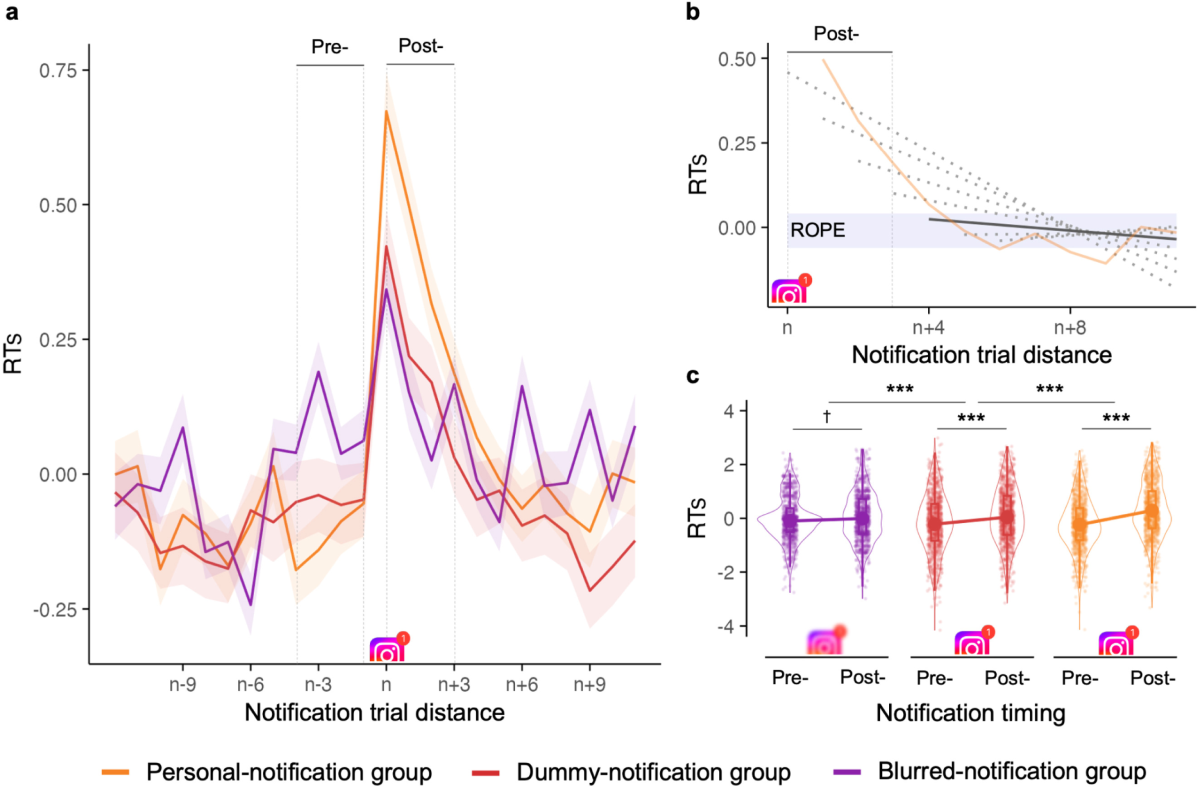
Fournier et al. believe that the reason notifications are distracting is not only because they suddenly appear on the screen, but also because users become accustomed to the notifications and feel that they might be relevant to them.
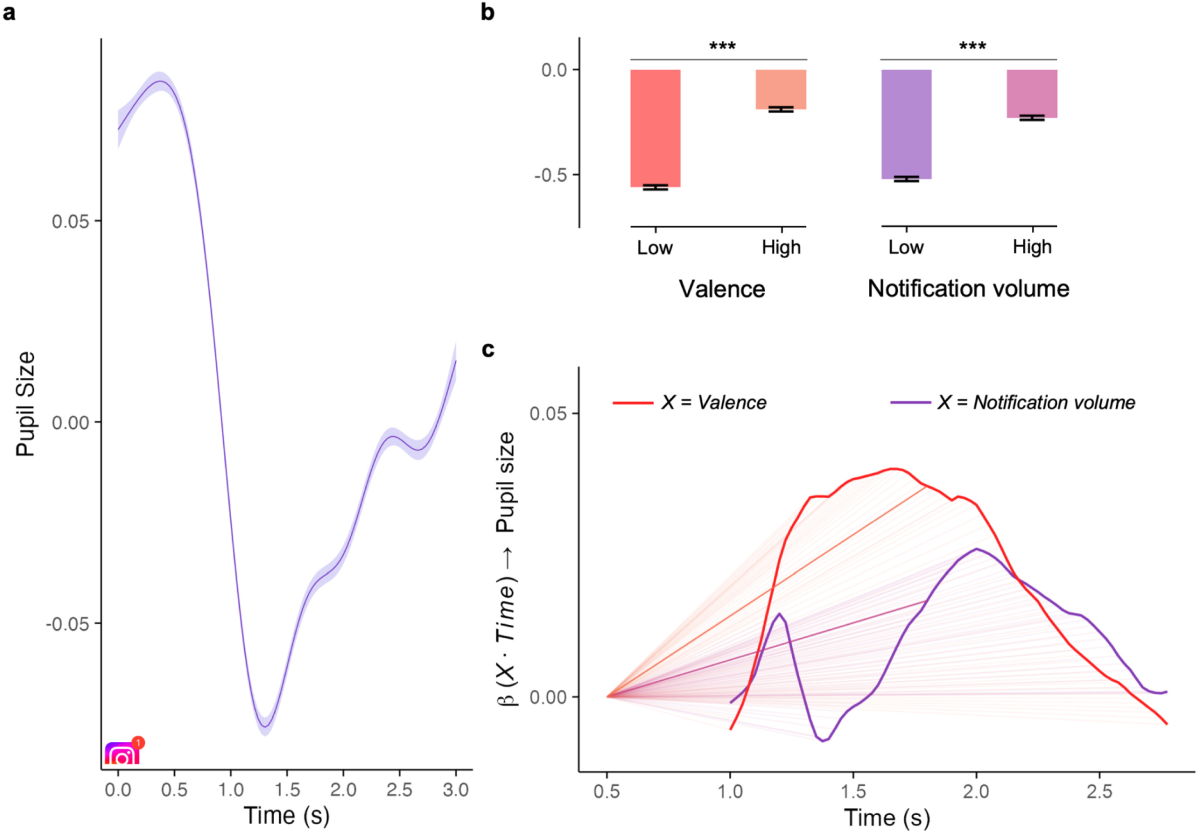
Fournier and his colleagues also measured pupil dilation during the experiment. Pupil dilation is used as one indicator of how much attention is being paid and how much strain is being placed on the eyes. In this study, the pupil dilation showed a similar trend to the reaction time results.
Graph a below shows the change in pupil size over time after notification, graph b shows the difference in pupil size depending on how the notification is received and the notification volume, and graph c shows how each factor is reflected in pupil size changes over time.
To investigate the relationship with smartphone usage, the research team collected and analyzed three weeks' worth of smartphone usage data from participants. The results showed that the degree of disruption to concentration was strongly linked not to how long people used their smartphones each day, but rather to how many notifications they received and how frequently they checked their smartphones.
However, it is not possible to conclude from these research findings alone that 'all notifications are bad' or 'it's better not to use social media,' and Fournier et al. also state that such simplistic interpretations should be avoided. Furthermore, limitations of the study include the fact that pupil measurements may be affected by body movement and screen brightness, and that the notifications used in this study were mainly those that are likely to be received positively, while notifications that strongly incite anxiety were not sufficiently examined.
Related Posts:




in Science, Smartphone, Posted by log1b_ok