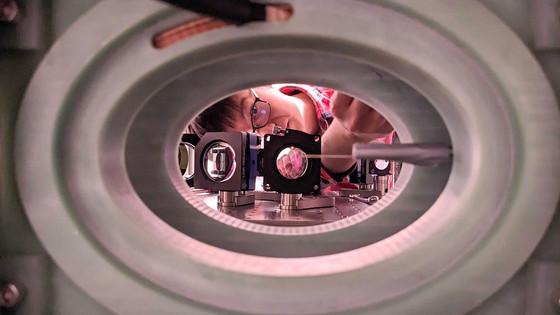
A strontium optical lattice clock that drifts by only one second in 30 billion years has been completed, reaching a level necessary to redefine the 'second.'
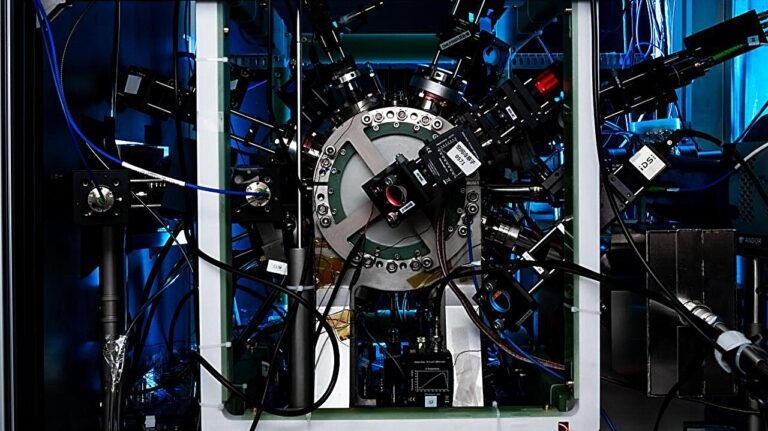
A research team led by Ji Peng Jia of the University of Science and Technology of China has reported improvements to a strontium optical lattice clock that has been in use at the university, reducing the estimated deviation due to the device and environment to 9.2 × 10⁻¹⁹. Jia and his colleagues say that this performance has reached the level required for the future redefinition of the 'second.'
Improved systematic evaluation of a strontium optical clock with uncertainty below 1×10⁻¹⁸ - IOPscience
https://iopscience.iop.org/article/10.1088/1681-7575/ae449e
This New Clock Is So Precise It Could Soon Redefine The Second - ScienceAlert
https://www.sciencealert.com/this-new-clock-is-so-precise-it-could-soon-redefine-the-second

According to international rules, one second is defined based on a specific vibration of the atom cesium-133 . Specifically, one second is the time it takes for cesium-133 to vibrate 9,192,631,770 times. On the other hand, 'optical clocks,' which use light, have the potential to measure time more precisely than cesium atomic clocks, and are therefore being researched as a candidate for a new standard of time.
The clock that Jia and his colleagues improved this time is the 'Sr1 optical lattice clock,' one of the strontium optical lattice clocks operated by the University of Science and Technology of China. Jia and his colleagues reported that they reduced the estimated deviation due to the device and the surrounding environment to 9.2 × 10⁻¹⁹. Science media outlet Science Alert explained that this level of accuracy means that 'even if it is run continuously for about 30 billion years, the deviation will remain at about one second.'
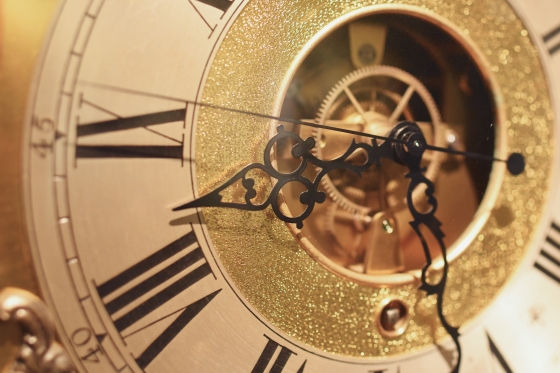
Zia and his colleagues investigated in detail major factors that disrupt the accuracy of clocks, such as ' blackbody radiation shift,' where the behavior of atoms is slightly altered by the heat radiation emitted from surrounding objects, and 'lattice light shift,' where the laser light that confines the atoms itself slightly shifts the clock reading.
Regarding the blackbody radiation shift, the uncertainty was evaluated by dividing the apparatus into small sections and calculating how heat spreads in a container with as little air as possible using a computer, and it was claimed that the uncertainty was reduced to 6.3 × 10⁻¹⁹.
Furthermore, Zia and his colleagues increased the beam of the laser confining the atoms, reducing the density of the atoms. By spreading the light with a device placed outside the vacuum chamber, the beam width increased from the conventional 37 µm to 155 µm. As a result, the amount of clock deviation due to the influence of atoms became -5.7 × 10⁻¹⁹ under normal clock operating conditions, which Zia and his colleagues say is about 1/30th of what it was in previous studies.
Furthermore, Zia et al. estimated the magnitude of the lattice light shift under normal clock operating conditions to be approximately 80.5 × 10⁻¹⁹, with an estimated range of 6.3 × 10⁻¹⁹. By using a high-performance mirror with minimal fluctuations in the device that stabilizes the laser frequency, they achieved extremely stable operation over long periods, reaching a frequency stability of 6.2 × 10⁻¹⁹ on average over 30,000 seconds.
As a result of these accumulated improvements, Mr. Zia and his colleagues position this clock as having met the '2 x 10 to the power of -18 condition for a single clock' required for the redefinition of the 'second'.
However, Zia and his colleagues explain that one of the important conditions for redefining the second is to operate at least three optical clocks using the same standard at different institutions, and to keep the estimated deviation of all error factors combined below '2 x 10⁻¹⁸' for each of them. This result alone will not immediately change the definition of the 'second.'
Related Posts: