Brain scans reveal why people eat even when they're full.

A recent study suggests that people who can't stop snacking late at night or reach for sweets even when full may not actually have weak willpower, but rather that it's due to the way their brains are wired.
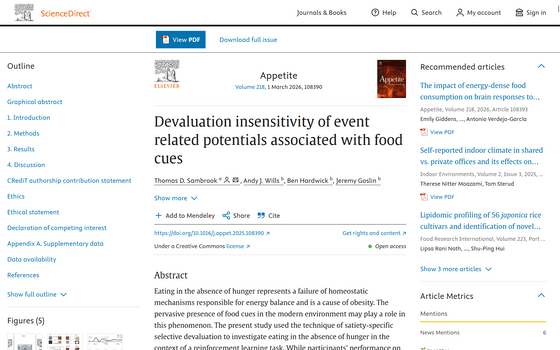
Devaluation insensitivity of event related potentials associated with food cues - ScienceDirect
Science reveals why you can't resist a snack – even when you're full | UEA
Psychologist Thomas Sunbrook conducted an experiment with 76 student volunteers. All participants had a BMI between 18.5 and 45, and those on diets or suffering from eating disorders were excluded.
Participants played a game multiple times in which they had to learn which food image would appear next based on a geometric pattern image, and were rewarded with their favorite food. However, the food was given in small amounts, and participants were asked to continue playing the game until they felt they had eaten no more.
Although the subjects felt full after the experiment, a surprising fact was revealed when their brainwaves were examined.

According to Sunbrook and colleagues, the brain continued to send a 'reward!' signal every time it saw an image of food, even if it was full. While the subjects' craving for food decreased significantly as the experiment continued, the brain continued to react to food with the same intensity from beginning to end.
Sunbrook said, 'Even if your stomach is full, your brain doesn't seem to care. No matter how full you feel, you can't stop your brain from reacting to delicious-looking food.'

The fact that the brain reacts simply to seeing images of food suggests that overeating and obesity may be influenced by the surrounding environment. For example, in a scenario where seeing many food-related advertisements leads to overeating, previous research has shown that 'obese children recognize more food-related advertisements than non-obese children, and overweight children overeat after seeing food cues.'
Sunbrook explained, 'No matter how full you are, the brain doesn't lower its evaluation of food as attractive. Even if you understand that you don't want the food, and even if you don't perceive value in the behavior, the moment food appears, the brain continues to send signals of 'reward!' This is a learned response formed over many years through the association of certain foods with pleasure. You may think you're eating because you're hungry, but in reality, your brain may simply be following a long-standing pattern.'
Related Posts: