Five types of DNA/RNA bases were discovered in samples from the asteroid Ryugu.
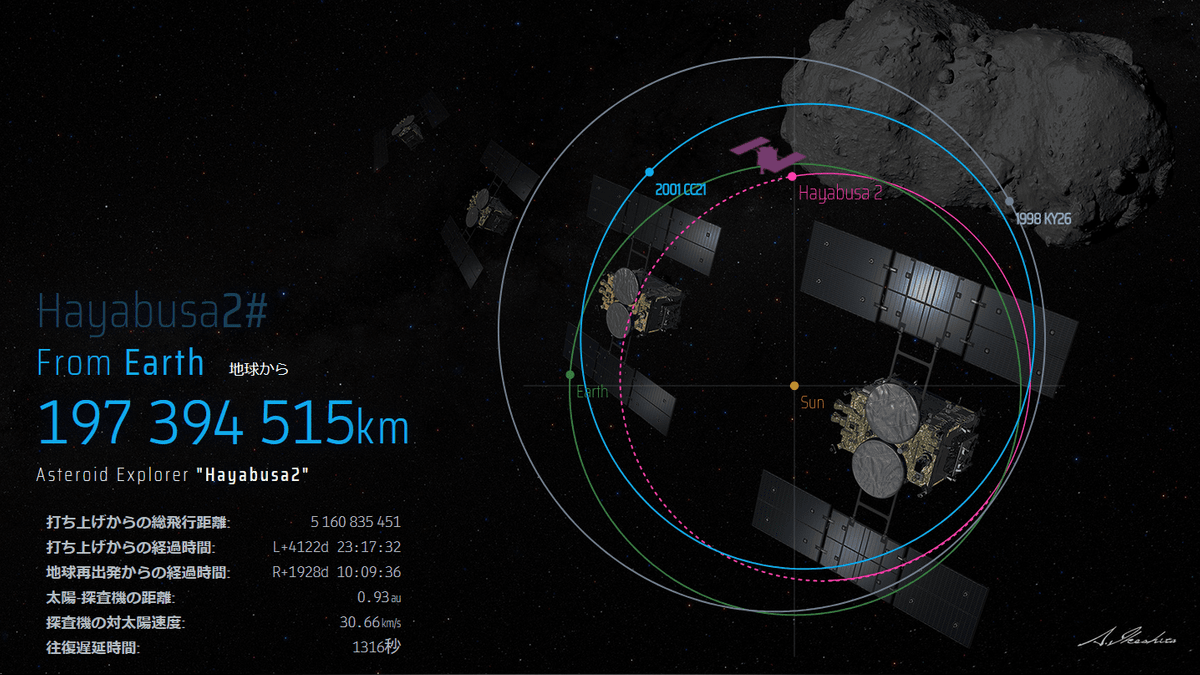
Samples collected from the asteroid Ryugu by the Japan Aerospace Exploration Agency (JAXA)'s Hayabusa2 mission have revealed that all five standard nucleic acid bases that make up DNA and RNA—adenine, cytosine, guanine, thymine, and uracil—were found.
A complete set of canonical nucleobases in the carbonaceous asteroid (162173) Ryugu | Nature Astronomy
https://www.nature.com/articles/s41550-026-02791-z
All five nucleic acid bases discovered from asteroid Ryugu samples | JAMSTEC | Japan Agency for Marine-Earth Science and Technology
https://www.jamstec.go.jp/j/about/press_release/20260317/
In 2014, Japan's Hayabusa2 spacecraft embarked on a mission to collect samples from the asteroid Ryugu, which is approximately 900 meters in size. In 2020, Hayabusa2 successfully brought back approximately 5.4g of samples to Earth, far exceeding the design target sample yield (0.1g). A 2023 study showed that these samples contained uracil, one of the four bases that make up RNA.
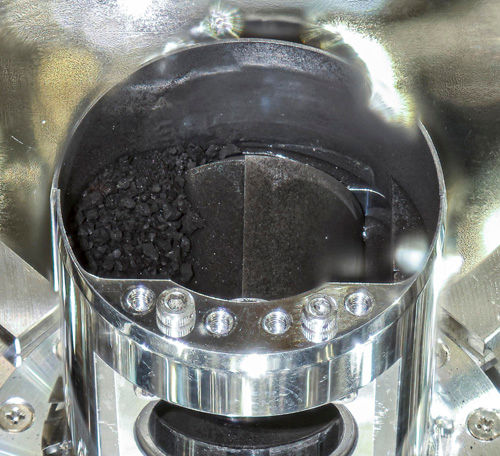
JAXA
Researchers who obtained additional samples from this collection were able to perform highly accurate analyses and evaluations that were not possible previously due to limitations in sample volume. As a result, they revealed that the samples contain all five types of bases that are components of DNA and RNA.
The researchers stated, 'In the chemical evolution prior to the origin of life, the 'RNA world hypothesis' has been proposed, which posits that RNA functioned not only as a carrier of genetic information but also as a catalyst. This hypothesis is accepted as one of the leading theories leading to the origin of life. Therefore, understanding the environment in which the nucleic acid bases that make up RNA were produced and how they were supplied to the early Earth is an important challenge in the study of the origin of life.'
In this analysis, in addition to the five major nucleic acid bases, related molecules such as hypoxanthine and xanthine, 6-methyluracil (a structural isomer of thymine), nicotinic acid (vitamin B3) and its congeners, and other nitrogen-containing organic molecules (amino acids, urea, ethanolamine) were newly detected.
The researchers stated, 'These results indicate that the soluble organic molecules present in the Ryugu sample are more diverse than previously thought. In particular, the detection of 6-methyluracil, which does not exist on Earth, is important evidence that the nucleic acid bases in the Ryugu sample are of non-biological origin and originate from the fresh asteroid Ryugu.'
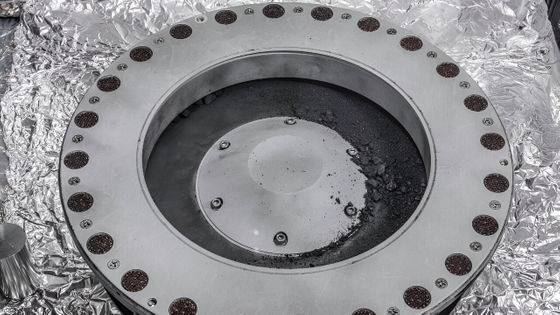
Samples brought back from the asteroid Bennu by NASA's OSIRIS-REx spacecraft in 2023 also contained adenine, guanine, cytosine, thymine, and uracil, similar to the findings in this study. Researchers note that the discovery of all five nucleic acid bases from the two asteroids 'means that the components of genetic material were universally generated during the formation of the solar system.'
Furthermore, the discovery of molecules that form the basis of life on Earth in Bennu and other locations has been pointed out as supporting the pseudo-panspermia theory , which posits that many of the small organic molecules used by life originated in space. There is also the panspermia theory, which posits that life originated on another celestial body and that life on Earth originated from something that came from space, but there is also the view that 'this only raises a new question: how did that organism that came from space come about, and it cannot be called a theory of the origin of life.'
In this study, researchers compared the Orgueil meteorite, Ryugu, and Bennu, all of which had previously struck Earth, and found a negative correlation between ammonia concentration and the purine/pyrimidine ratio. The researchers pointed out that 'such a correlation between ammonia concentration and nucleic acid base synthesis has not been reported in previous laboratory experiments and is an important indicator for understanding the mechanism of extraterrestrial nucleic acid base production.'
The researchers say they plan to conduct high-precision analyses of other solar system materials in addition to Ryugu and Bennu, and to more systematically clarify the relationship between nucleic acid base composition and ammonia concentration.
Related Posts:



in Note, Posted by log1p_kr