NVIDIA announces 'NemoClaw,' an open-source AI agent platform that allows for the deployment of OpenClaw with a single command while ensuring security.

NVIDIA CEO Jensen Huang announced ' NVIDIA NemoClaw ' for the OpenClaw community, an open-source AI agent platform, during his keynote address at the AI conference '
Safer AI Agents & Assistants with OpenClaw | NVIDIA NemoClaw
https://www.nvidia.com/en-us/ai/nemoclaw/
NVIDIA Announces NemoClaw for the OpenClaw Community | NVIDIA Newsroom
https://nvidianews.nvidia.com/news/nvidia-announces-nemoclaw
NVIDIA GTC Keynote 2026 - YouTube
It was reported in March 2026 that NemoClaw was under development.
NVIDIA is reportedly planning to release an open-source AI agent platform called 'NemoClaw,' possibly an OpenClaw-like tool - GIGAZINE
NemoClaw, now officially announced, is a stack that dramatically simplifies the deployment and operation of OpenClaw, an open-source AI agent platform. It allows OpenClaw to be installed with a single command, along with NVIDIA Nemotron models and the OpenShell runtime. This transforms the previously complex process of building AI assistants into something accessible and scalable for everyone.
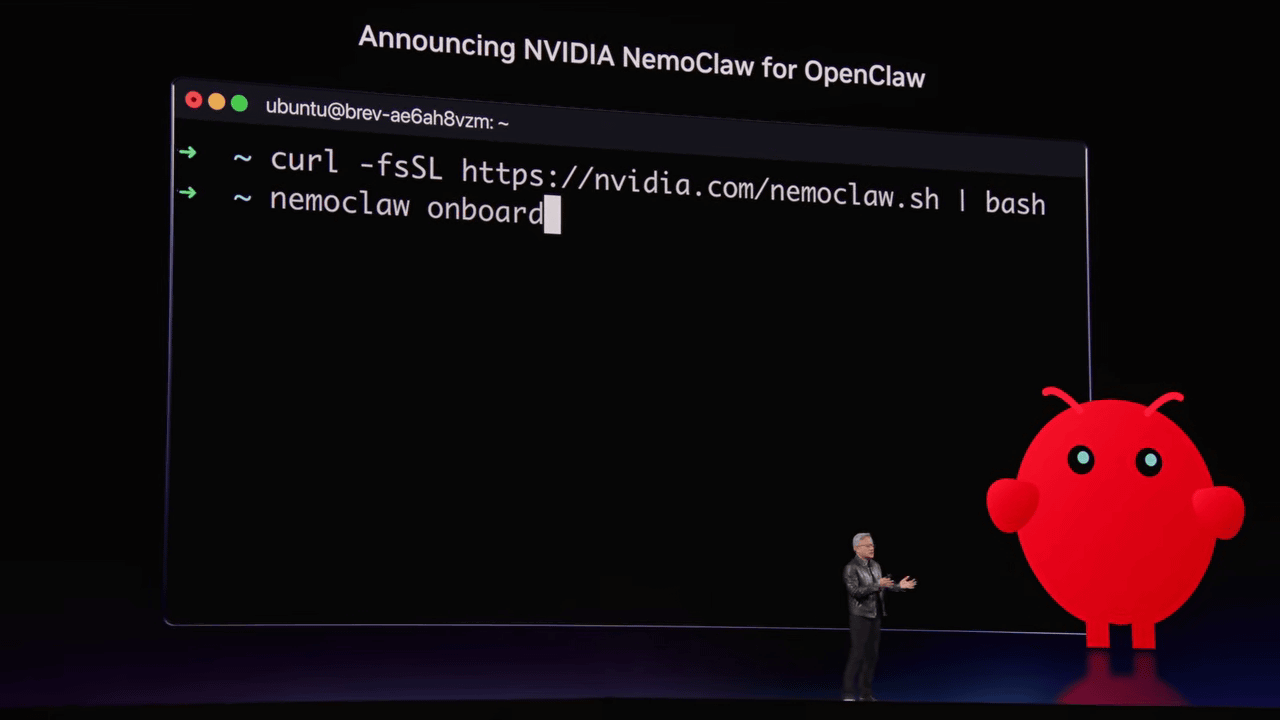
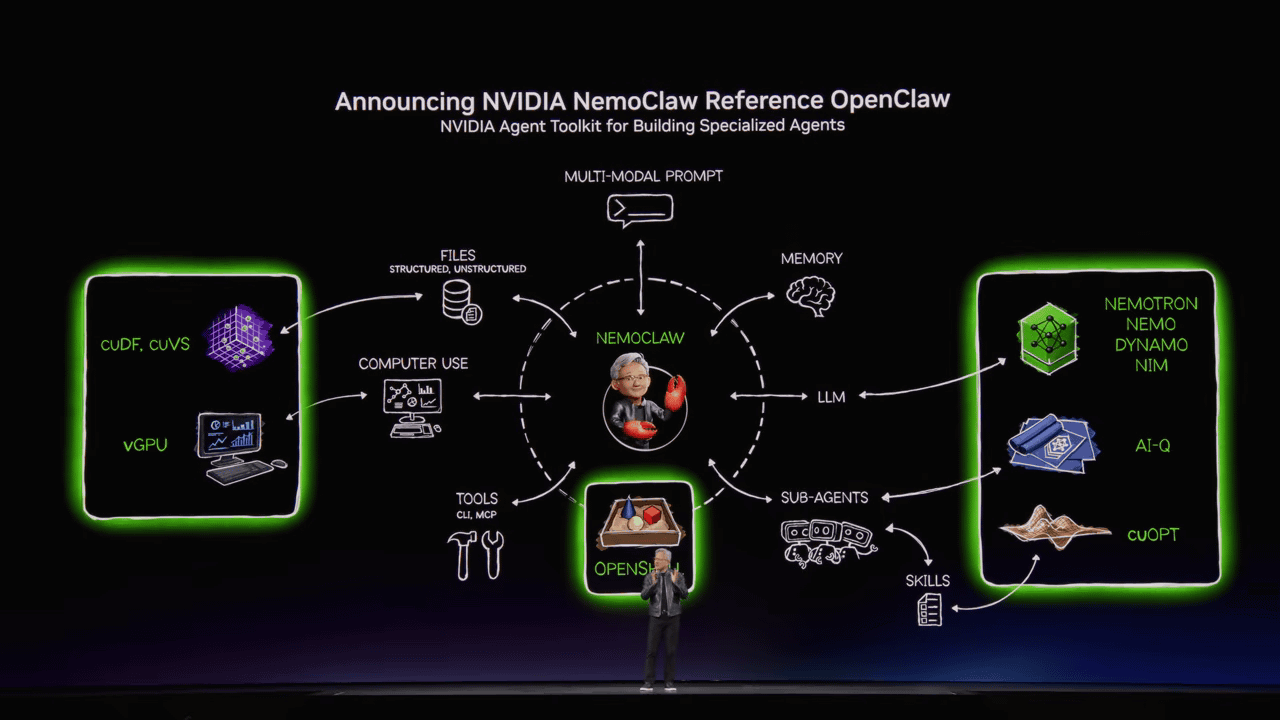
NemoClaw also optimizes OpenClaw's operation using NVIDIA Agent Toolkit software, supporting hybrid operation that flexibly combines local and cloud environments. Specifically, users can run NVIDIA Nemotron models directly on their own dedicated systems, while also utilizing state-of-the-art models in the cloud via a privacy router when more advanced processing is required. This allows agents to learn new skills within a defined framework and build a foundation for continuously completing tasks.
The wide range of operating environments is also a major strength, running on all NVIDIA platforms, from typical GeForce RTX-equipped laptops and desktop PCs to professional RTX PRO workstations, and even AI supercomputers like DGX Station and DGX Spark. This diverse hardware support provides dedicated computing resources to realize 'always-on' autonomous agents that can operate 24/7, 365 days a year.
NemoClaw's security is built on a robust guardrail provided by a runtime called OpenShell and a multi-layered protective shield. The AI agent operates in a secure, isolated environment called a sandbox, separated from the main system. This isolated environment is built using advanced technologies such as Landlock, seccomp, and netns, preventing the agent from arbitrarily changing critical settings on the PC or illegally obtaining administrative privileges.
At the network layer, all unauthorized external connections are automatically blocked. If an agent attempts to access an unknown destination not on the list, a notification requesting authorization will appear on the operation screen, and communication will not proceed until authorized by a human. At the file system layer, the agent's read and write capabilities are limited to specific directories only, and access to areas where users' private files are stored is completely restricted.
Furthermore, the process layer prevents attacks on the system itself by blocking dangerous commands that affect the core of the OS. In the inference layer, queries to the AI model are not made directly, but always routed through an OpenShell gateway. This ensures that interactions with the AI are constantly monitored and controlled, preventing unintended data leaks via the cloud.
At the time of writing, NemoClaw is available on GitHub as alpha software under the Apache-2.0 license. Installation requires a Linux environment of Ubuntu 22.04 LTS or later, Node.js version 20 or later (version 22 is recommended), npm version 10 or later, Docker, and NVIDIA OpenShell.
NVIDIA/NemoClaw: NVIDIA plugin for secure installation of OpenClaw
https://github.com/NVIDIA/NemoClaw
NVIDIA CEO Jensen Huang called OpenClaw 'an operating system for personal AI,' emphasizing that it marks the beginning of a new software renaissance that the industry has been waiting for. Peter Steinberger, the creator of OpenClaw, also stated that 'working with NVIDIA will provide a guardrail for everyone to build powerful and secure AI assistants.'
Related Posts: