Thousands of executives admit that AI has had little impact on employment or productivity, suggesting a return of the 'productivity paradox'

While advances in AI technology have raised hopes that various tasks will be delegated to AI,
Thousands of executives aren't seeing AI productivity boom, reminding economists of IT-era paradox | Fortune
https://fortune.com/2026/02/17/ai-productivity-paradox-ceo-study-robert-solow-information-technology-age/
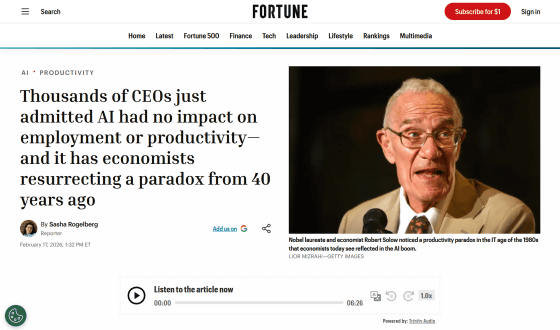
With the emergence of microprocessors and memory chips in the 1960s, economists and businesses expected these technologies to lead to massive productivity gains. While sophisticated computers generated vast amounts of information and detailed reports printed on reams of paper, productivity growth slowed, from 2.9% between 1948 and 1973 to just 1.1% since 1973.
In a 1987 article (PDF file) , Nobel Prize-winning economist Robert Solow explained, 'The computer age is everywhere, but it doesn't show up in productivity statistics.' This phenomenon, where the spread of IT technology and productivity growth are diverging, is known as the ' productivity paradox.'
Fortune states, 'New data on executives' use of AI suggests history is repeating itself,' pointing out that a similar productivity paradox is evident in the widespread adoption of modern AI technologies.
Of the companies included in the S&P 500, a representative group of companies in the US stock market, 374 mentioned AI in their earnings presentations, and most of them explained that their internal AI adoption was going well. However, an analysis by the financial newspaper Financial Times for 2024-2025 showed that the adoption of AI has not led to improved productivity.
In addition, a survey released by the National Bureau of Economic Research in February 2026 surveyed approximately 6,000 CEOs, CFOs, and other corporate executives in the United States, the United Kingdom, Germany, and Australia, and found that approximately 90% responded that AI had had little impact on employment or productivity over the past three years. However, expectations for AI remain high, with corporate executives predicting that AI will increase productivity by 1.4% and output by 0.8% over the next three years, while employment will decrease by 0.7%.
In 2023, researchers at the Massachusetts Institute of Technology (MIT) claimed that AI could improve worker performance by approximately 40% . However, recent data has shown no improvement in productivity due to the introduction of AI, leaving corporate executives who have invested heavily in AI to question when their investments will be recouped and whether the benefits will ever be seen.
Torsten Slok, chief economist at asset management firm Apollo, cited the productivity paradox in a February 2026 article , stating, 'AI is everywhere except for incoming macroeconomic data. Currently, we don't see AI involved in employment, productivity, or inflation data.' He also noted that most S&P 500 companies, with the exception of Amazon, Apple, Alphabet, NVIDIA, Tesla, Microsoft, and Meta, don't use AI in their profit margins or revenue forecasts.
The trend of accepting AI but not seeing its benefits is also spreading among frontline workers. A survey of approximately 14,000 workers in 19 countries by ManpowerGroup, a human resources solutions company, found that by 2025, the number of workers who regularly use AI will increase by 13%, but their trust in AI will also decrease by 18%.
Even from a long-term perspective, it has been pointed out that replacing employees with AI will result in significant losses. If companies reduce the hiring of young employees whose jobs are easily replaced by AI, their internal talent pipeline will be stagnate, and they risk being unable to secure key employees who can move on to middle management positions. IBM's Chief Human Resources Officer, Nickell Lamoreaux, pointed out this risk and announced a policy to triple the number of entry-level hires in the United States by 2026.
Replacing employees with AI will result in huge losses in the future - GIGAZINE

While there is pessimism about AI technology and productivity growth, Fortune argues that the productivity paradox may be resolved. In fact, the spread of IT technology did not lead to rapid productivity growth, but it did lead to a productivity surge from the mid-1990s to the early 2000s, with productivity increasing by 1.5% from 1995 to 2005.
Slok also believes that AI has the potential to improve productivity in the future, but points out that there are differences between IT and AI. In the early days of the IT field in the 1980s, innovators who developed innovative products had the monopoly power to set prices, and this situation continued until competitors developed similar products. However, today, fierce competition among large AI development companies has unfolded, and AI tools are now affordable and available to anyone.
Sloak argued that the future of AI-driven productivity will depend on how companies are willing to embrace AI and continue to incorporate it into the workplace. 'From a macro perspective, AI value creation is not about the product, but about how generative AI is used and implemented across various sectors of the economy,' he said.
Related Posts:






in AI, Posted by log1h_ik