Europe accelerates push for its own digital payment system to reduce reliance on Visa and Mastercard
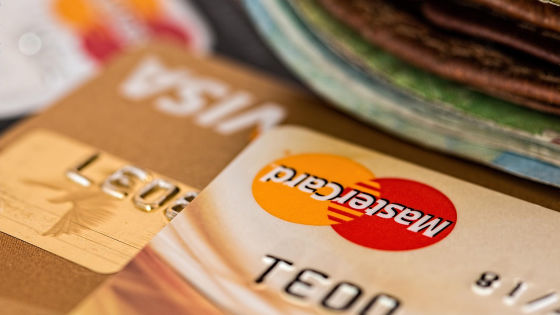
Nowadays, many people use credit cards such as Visa and Mastercard, but because these are American companies, there is a problem that payment history and personal information are passed on to overseas companies. Therefore, in Europe, there is a growing movement to promote its own digital payment system in order to reduce dependence on overseas payment methods such as Visa and Mastercard.
Europe's $24 Trillion Breakup With Visa and Mastercard
https://europeanbusinessmagazine.com/business/europes-24-trillion-breakup-with-visa-and-mastercard-has-begun/
European alternatives to Visa and Mastercard 'urgently' needed, says banking chief
https://www.ft.com/content/fcc215bb-b7b8-4a62-87ed-03f603eb3d14
In January 2026, European Central Bank (ECB) President Christine Lagarde appeared on an Irish radio show and pointed out that almost all card and mobile payments in Europe are made through American or Chinese infrastructure such as Visa, Mastercard, PayPal, and Alibaba, and argued that Europe urgently needs its own digital payment system to overcome this situation.
European Business Magazine, a European business publication, states, 'Every time a European taps their card, pays online, or splits a bill with a friend, the transaction passes through infrastructure owned and operated by American companies.' 'Card payments account for 56% of all cashless transactions in the EU. And the data on who bought what, where, when, and for how much has always remained outside of European jurisdiction.'
While energy, defense, resources, and food are often highlighted as areas of dependence on the United States and other countries, digital payments tend to be a blind spot in the discussion. Most consumers are unaware that their data is routinely leaked overseas, and that the United States could shut down payment services and disrupt the economy if it so chose. In 2022, in response to Russia's invasion of Ukraine, Visa and Mastercard suspended payments within Russia .
Martina Weimert, CEO of the European Payments Initiative (EPI) , an integrated digital payments service backed by 16 European banks and financial services companies, said Europe must quickly reduce its reliance on American companies like Visa and Mastercard. 'Europe has great assets, like domestic payment card systems, but nothing that crosses borders,' she said, arguing that alternative payment methods are needed to ensure Europe's independence.
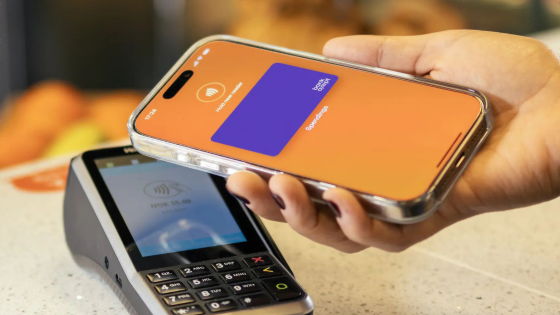
To address this situation, EPI launched Wero , a mobile payment service unique to Europe, in 2024. Wero is a service that allows users to send money using only a phone number, without the need for intermediaries or cards. Wero already has 48.5 million users in Belgium, France, and Germany, and its retail payment service began in Germany at the end of 2025, with service scheduled to begin in France and Belgium in 2026.
On February 2, 2026, the EuroPA Alliance , which aims to develop unique European payment solutions, signed a memorandum of understanding with EPI. EuroPA is an initiative that includes the Italian interbank network Bancomat , the Spanish mobile payment service Bizum , the Portuguese payment service company SIBS , and the Nordic payment service Vipps MobilePay .
EPI Company | Bancomat, Bizum, EPI, SIBS and Vipps MobilePay sign MoU…
https://epicompany.eu/media-insights/bancomat-bizum-epi-sibs-and-vipps-mobilepay-sign-mou-to-accelerate-the-rollout-of-sovereign-pan-european-payment-solutions
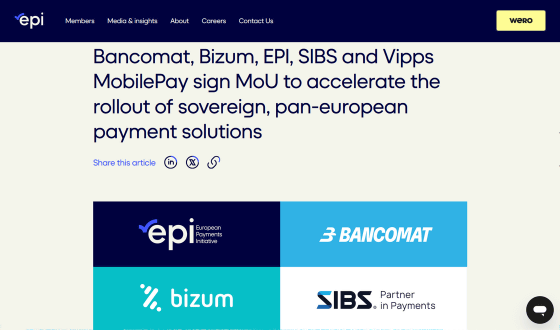
The MoU will connect approximately 130 million users across 13 countries to Wero. Direct transactions under this initiative are expected to begin in 2026, with e-commerce and point-of-sale payment services expected to launch in 2027. Commenting on the MoU, Weimert said, 'European payments sovereignty is not just a vision, it's a reality that is being realized.'
European Business Magazine points out that there have been similar attempts to create independent payment services in Europe in the past, but they have failed due to national pride and conflicts of interest between banks. Furthermore, large companies like Visa and Mastercard already have a large customer base, which has also hindered the development of independent payment services. In light of these issues, EuroPA is focusing on linking existing payment services in each country.
While the EPI-EuroPA Memorandum of Understanding is a promising step toward establishing a European payment system, displacing Visa and Mastercard will not be easy. According to EPI's own estimates, billions of euros of investment would be required for EPI to become a viable alternative to Visa and Mastercard. Challenges include reduced profitability due to EU regulations restricting fees, ingrained consumer habits, and countermeasures by Visa and Mastercard.
However, European Business Magazine argues that there are strong political forces favoring the realization of a European settlement system, including the push for a Capital Markets Union to unify capital markets within the EU and intensifying competition among major powers. Lagarde stated, 'We have the assets and the opportunity to achieve this. Removing Europe's self-imposed internal barriers would significantly increase its economic wealth.'
Related Posts:

in Note, Posted by log1h_ik