Experiments show that 'manipulating the content of lucid dreams' may improve people's problem-solving abilities

In the Hollywood movie '
Creative problem-solving after experimentally provoking dreams of unsolved puzzles during REM sleep | Neuroscience of Consciousness | Oxford Academic
https://academic.oup.com/nc/article/2026/1/niaf067/8456489
'Dream engineering' experiment hints at why 'sleeping on it' helps with problem-solving | Live Science
https://www.livescience.com/health/sleep/scientists-infiltrated-volunteers-dreams-to-boost-their-creative-thinking
When you're stuck on a problem, you're often told to 'get some sleep and think about it.' In fact, a 2012 study found that volunteers who were asked to solve association problems performed better after sleeping than the group that stayed awake.
To investigate why sleep is associated with improved problem-solving ability, a research team led by Professor Ken Perler, a cognitive neuroscientist at Northwestern University in the United States, conducted an experiment in which they manipulated the subjects' dreams. Perler told the science media Live Science, 'The purpose of this study was to investigate whether dreaming is related to the benefits of sleep for problem-solving.'
The research team recruited 20 participants who had already demonstrated lucid dreaming in the lab or who reported experiencing lucid dreams at least once a month. In the lab, the participants completed a variety of timed puzzles, including matchstick puzzles, emoji puzzles, language puzzles, and spatial puzzles.
While participants were solving each puzzle, a specific piece of music was played, and they were asked to remember the combination of the puzzle and the music. The combination of puzzle and music was different for each participant, and varied from guitar tunes to whistling tunes to drum tunes.
The puzzles were set to a high level of difficulty, and the task ended when the participants failed to solve four puzzles within the time limit. The research team then played music associated with the unsolved puzzles to see if the participants remembered the puzzle-music pairing.

After completing the puzzle task, participants were instructed not to think about the answer until they dreamed. They were then invited to sleep in the laboratory. They were told that they would be woken at 4:00 AM and undergo a lucid dreaming procedure ( Targeted Lucidity Reactivation, or TLR ) using sensory stimuli. They were also told that if they were experiencing a lucid dream, they would be asked to use specific eye movements, if they heard music related to the puzzle, they would be asked to solve the puzzle in their dream, and if they were working on the puzzle in their lucid dream, they would be asked to use specific breathing techniques.
The researchers woke the participants at 4 a.m. as instructed, performed TLR to induce lucid dreaming, and then played music associated with two of the four unsolved puzzles while the participants were in REM sleep.
Participants were awakened after the REM sleep period and asked questions about their dreams, including whether they heard music or worked on puzzles. They were given the opportunity to complete the unsolved puzzles the next morning and then again after a seven-day follow-up period. Participants continued to keep a dream diary and report their dreams, but were instructed not to work on the unsolved puzzles while awake.
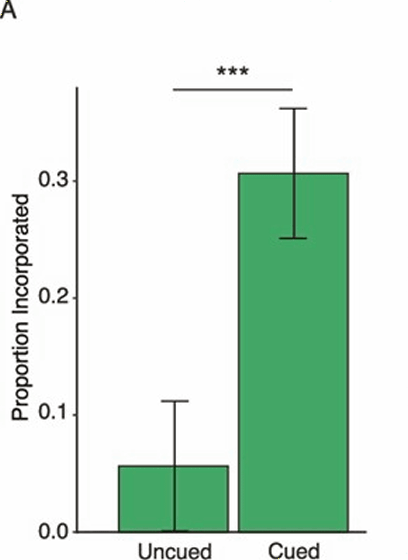
The results showed that 15 of the 20 participants reported at least one dream related to an unsolved puzzle, that participants were more likely to dream about puzzles related to the music they listened to during REM sleep, and that six participants practiced eye movement and breathing techniques while sleeping and informed the scientists that they were experiencing lucid dreams and solving puzzles.
The graph below shows the percentage of people who dreamed about puzzles without associated music during REM sleep (left) and the percentage of people who dreamed about puzzles with associated music (right).
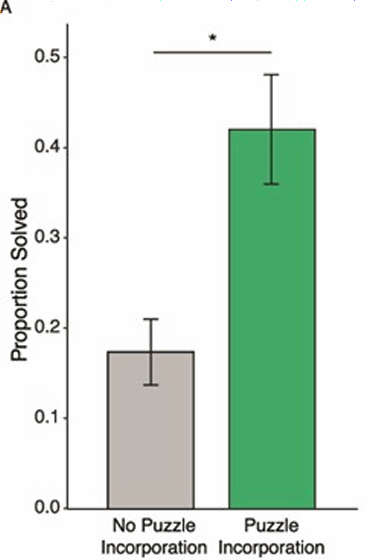
Furthermore, the researchers found that unsolved puzzles that appeared in participants' dreams were more likely to be solved in subsequent sessions than puzzles that did not appear in their dreams.
The graph below shows the percentage of puzzles solved that did not appear in the dream (left) and the percentage of puzzles solved that did appear in the dream (right). The percentage of puzzles that did not appear in the dream that were solved was 17%, but the percentage of puzzles that appeared in the dream that were solved reached 42%.
The results of this study only show a correlation: the puzzles that participants dreamed about were more likely to be solvable. It does not prove a causal relationship: dreaming about puzzles helps solve them. It is possible that participants were simply closer to the answer and more likely to dream about puzzles that they could solve.
While dream research is challenging because people are unlikely to remember their dreams, scientists are slowly uncovering what happens in the brain during sleep. 'I think science is fun when there's still so much to understand and we're not there yet,' Parler told Live Science.
Related Posts:





in Free Member, Science, Posted by log1h_ik