What is the history of how haggis, made from sheep's innards stuffed into the stomach, became a traditional Scottish dish?
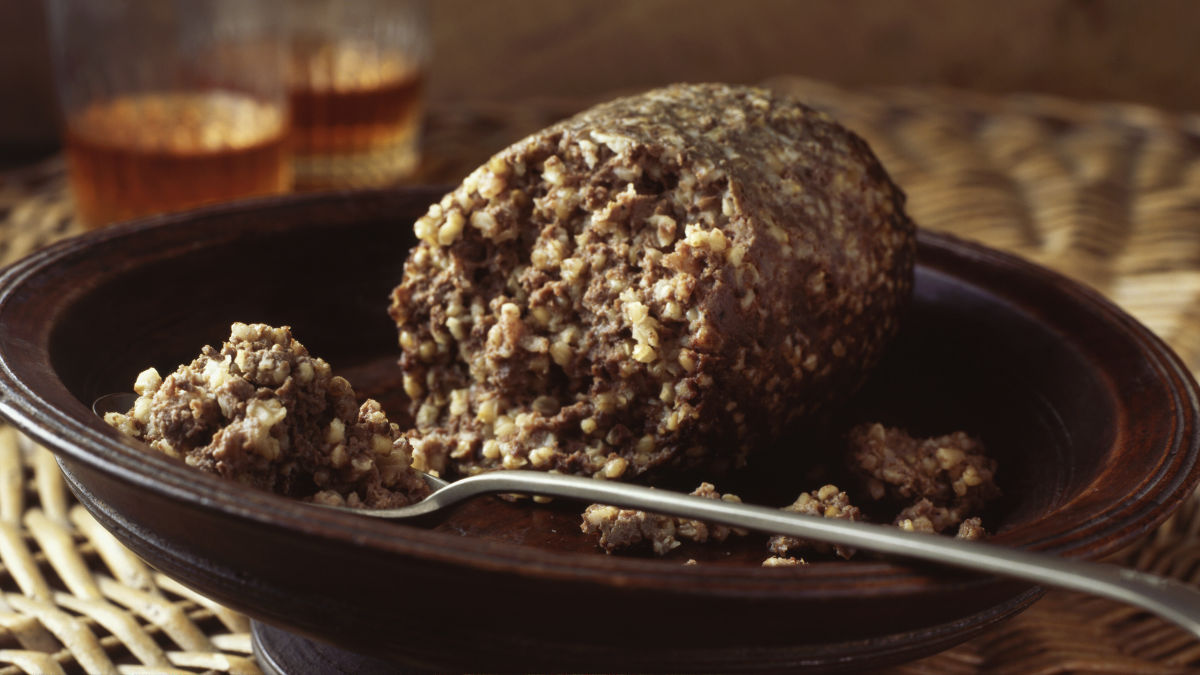
A History of Haggis | History Today
https://www.historytoday.com/archive/historians-cookbook/history-haggis

In 2009, Glasgow -born food culture researcher Catherine Brown sparked controversy by claiming that haggis was actually an English dish, which caused outrage in Scotland, but the origins of haggis are actually shrouded in mystery.
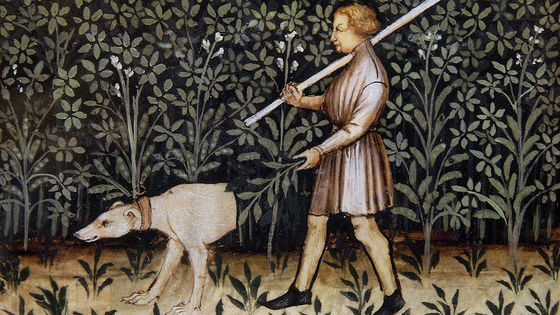
Lee says it's unclear where haggis originated, but suggests that there are several theories, including that it was first created by the Romans to preserve the innards of hunted animals and then introduced to the UK; that the original haggis was brought over by Scandinavian Vikings between the 8th and 13th centuries; and that the original haggis originated in France and was brought to Scotland after 1295.
However, none of these theories are convincing or well-founded, and are all based on speculation. Considering that modern sausages are essentially similar to haggis, and that similar dishes have been made throughout Europe for quite some time, it is not surprising that the earliest form of haggis originated somewhere in Great Britain .
Lee points out that the earliest references to haggis-like dishes can be found in English texts. The Forme of Cury , written in 1390 by King Richard II 's chief chef, contains a recipe for a dish called 'raysols,' made from ground meat cooked in pig membranes . The word 'Haggis' or 'Hagws' first appears in a recipe from about 40 years later.
Additionally, the English Latin Dictionary, Promptorium parvulorum , written around 1440 by Geoffrey the Grammarian, a monk from Norfolk, England , includes the name 'Hagas.' Although the recipe for Hagas is not given, it is defined as a type of pudding , and it is thought that it probably contained lamb.
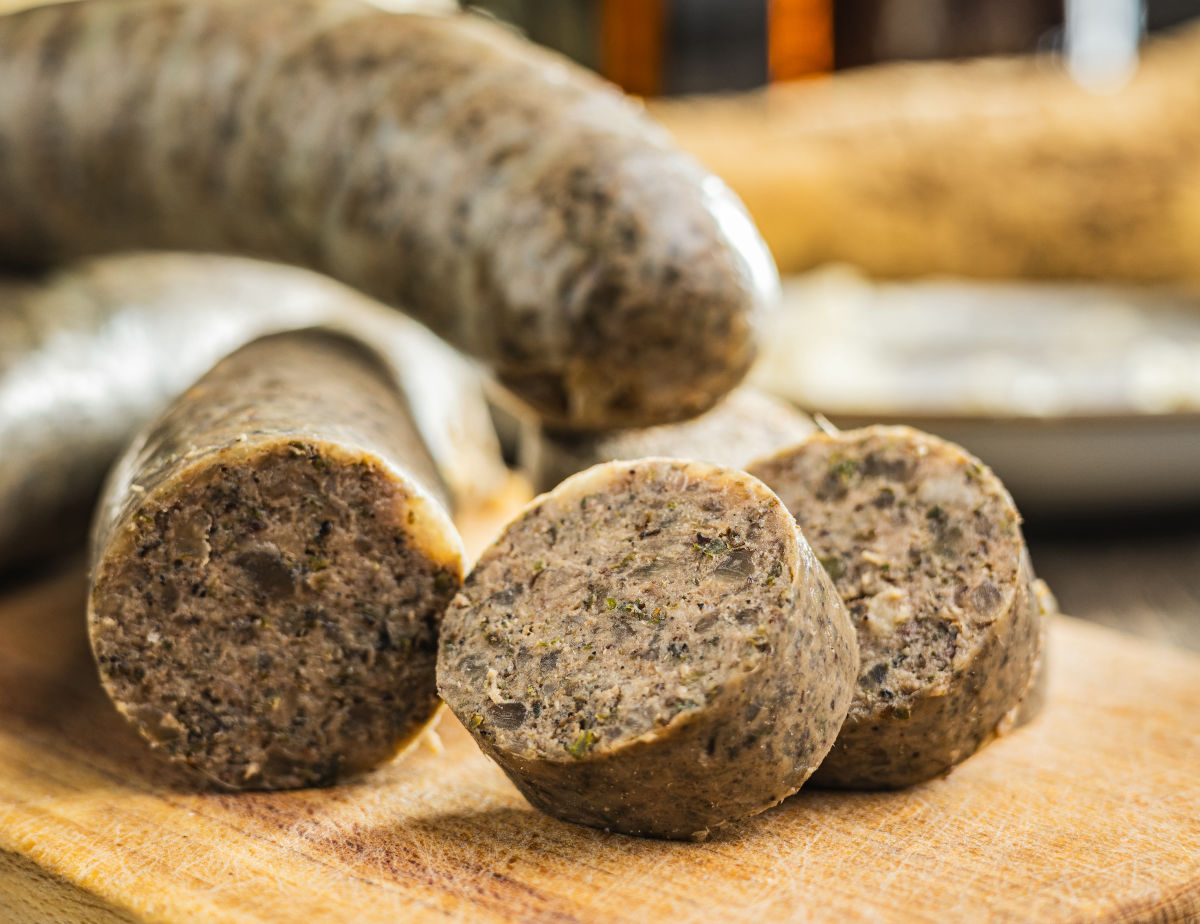
The fact that the oldest document mentioning haggis is from England does not prove that it originated in England. However, the inclusion of haggis in a recipe book written in
However, haggis at that time was merely one of the 'dishes people were eating' and was not claimed to be a Scottish or English dish. There were several factors behind haggis being considered a Scottish dish, and Lee argues that it was the English who first considered haggis to be Scottish.
The first factor is 'changing consumption patterns.' In England, productivity had increased dramatically by the end of the 17th century due to the Industrial Revolution. This made it possible to import a wide variety of high-quality agricultural products, and the domestic market for animal offal shrank, so haggis, which uses animal offal, was rarely eaten except by the poor. Meanwhile, in Scotland, the economy declined at the same time, and many people found it difficult to make ends meet, so cheap haggis became widely eaten.
The second factor was 'political prejudice.' England and Scotland formed the Kingdom of Great Britain through the Act of Union in 1707, but the English still viewed the Scots as barbarians. In the process, haggis, which was no longer found in England at the time, was also targeted, and haggis came to be seen as a 'barbaric dish unique to Scotland,' Lee explains.
While the English considered haggis barbaric, the Scots began to proudly claim it as their own. In 1822, when King George IV of England visited Scotland, haggis was served as one of Scotland's representative dishes, and later eating haggis became popular among Scots living abroad.

by James Stringer
Lee said the origins of haggis will always be a matter of debate, but that it will likely remain unresolved until conclusive evidence emerges. 'In a way, I hope it will never be resolved,' he said. 'The journey of haggis from its mysterious origins to a traditional Scottish dish is as moving as haggis itself.'
Related Posts:




in Food, Posted by log1h_ik