China introduced a 'condom tax' to boost birth rates, but experts point out that it has had little effect

China will impose a tax on contraceptives, including condoms, oral contraceptives, and birth control devices, effective January 1, 2026. The tax on contraceptives is a policy aimed at improving China's low birth rate, but sociologists studying China's demographics say it has had 'little effect.'
China's new condom tax will prove no effective barrier to country's declining fertility rate

China's total fertility rate , which is an indicator of the number of children a woman gives birth to in her lifetime, is around 1.0, the lowest in the world. In October 2025, Chinese authorities implemented a national childcare program to provide more than 3,600 yuan (approximately 80,000 yen) for each child under the age of three as part of an effort to improve the country's stagnant birth rate. However, the number of deaths still exceeded the number of births.
As part of the birth rate improvement policy, a new tax system imposing a 13% sales tax on contraceptives was implemented on January 1, 2026. However, according to Dudley L. Poston Jr., a professor of sociology at Texas A&M University , taxing contraceptives may only have a small effect on the total fertility rate, and is thought to have little effect.

The first reason is the burden of the tax. In China, a box of condoms costs about 50 yuan (about $11), and a month's supply of oral contraceptives costs an average of 130 yuan (about $30). Even a 13% tax would only increase the cost of a box of condoms by about 5 to 10 yuan (about $22), which is not enough to discourage people from purchasing essential items. Speaking to the BBC, Daniel Luo, a resident of Henan Province in eastern China, said, 'Just like a subway fare increase of a few yuan (a few tens of yen) won't change your habits, a yearly increase in condoms of a few hundred yuan (a few thousand yen) isn't enough to worry about. I have one child, but I don't want any more.'
Poston Jr. also points out that countries that have implemented pro-natalist policies, like China, have not been successful. For decades, Singapore has implemented measures to increase its birthrate through systems such as paid maternity leave, childcare subsidies, and lump-sum payments, but its birthrate remains the world's lowest at 1.2 by 2025. In 2012, the Singaporean government partnered with candy manufacturer Mentos to implement 'National Night,' a project to incite patriotism among Singaporeans, but this did not lead to an increase in births. The campaign video for 'National Night' is below.
South Korea, which has the world's lowest birth rate of 0.7, has been offering economic incentives for at least 20 years to improve its birth rate. However, South Korea's birth rate has continued to decline from 1.1 in 2006 to 1.0 in 2017, 0.9 in 2019, and 0.7 in 2024. Financial incentives are unlikely to improve the birth rate, Poston Jr. said.
China implemented a one-child policy from 1979 to 2014, causing the birthrate to fall from over 7.0 in the early 1960s to 1.5 in 2015. Modernization has also led to improved education and employment opportunities for women, causing many women to postpone childbirth, which is also a factor in the decline in the birthrate. Additionally, rising living and education costs are also reasons why Chinese couples do not want to have many children. Taxing contraceptives has not directly addressed these specific causes of the declining birthrate.
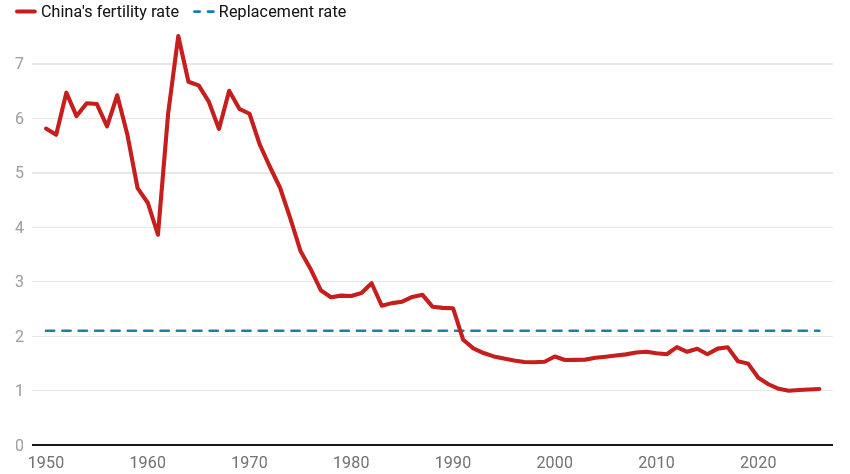
Another factor to consider is what demographers call the 'low fertility trap.' The low fertility trap is the hypothesis that when a country's total fertility rate falls, attitudes and values regarding having children change, making it difficult to improve the total fertility rate. In the past, demographers proposed a total fertility rate of 1.5 or 1.4, below which it would be difficult to improve due to the low fertility trap. China's current rate is far below this, so raising it from that point could be extremely difficult.
'For these reasons, it is highly unlikely that China's policies will have any impact on increasing the birth rate,' Poston Jr. concluded. 'Furthermore, based on my many years of experience studying China's demographics, I believe that even a small increase in the price of contraceptives would have little effect.'
Related Posts:








in Note, Posted by log1e_dh