An AI model will be developed that can predict the risk of over 100 diseases from just one night of sleep

It is known that sleep is closely related to physical and mental health, and when health conditions deteriorate, sleep is often adversely affected. A research team at Stanford University School of Medicine has recently reported that they have developed an AI model called ' SleepFM ' that predicts the risk of more than 100 diseases from a single night's sleep.
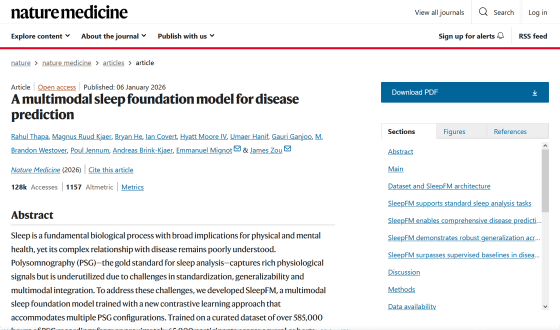
A multimodal sleep foundation model for disease prediction | Nature Medicine
New AI model predicts disease risk while you sleep
https://med.stanford.edu/news/all-news/2026/01/ai-sleep-disease.html
A Single Night's Sleep Could Predict Your Risk For More Than 100 Diseases : ScienceAlert
https://www.sciencealert.com/a-single-nights-sleep-could-predict-your-risk-for-more-than-100-diseases
To develop SleepFM, the research team used approximately 585,000 hours of sleep data collected every 5 seconds from 65,000 subjects. This sleep data was collected using polysomnography (PSG), a technique that uses various sensors attached to the body to record brain, heart, respiratory activity, eye and leg movements, and other sleep data .
'When we study sleep, we record an incredible number of signals. It's a kind of universal physiological data, and we study fully restrained subjects over eight hours. It's a very rich data set,' said Emmanuel Mignot, co-author of the paper and professor of sleep medicine at Stanford University.
The research team built a foundational model to develop SleepFM. While large-scale language models like OpenAI's GPT series are trained on massive amounts of text data, SleepFM is trained on sleep data collected by PSG rather than text data. 'SleepFM is essentially learning the language of sleep,' said James Zou, co-author of the paper and associate professor of biomedical data science at Stanford University.
SleepFM integrates multiple data streams, including EEG, ECG, EMG, pulse, and respiration, and understands how they relate to each other. To achieve this, the research team developed a new training method called 'leave-one-out contrast learning,' which hides one piece of data and then reconstructs it from the other data.
'One of the technological advances we've made in this research is figuring out how to harmonize all these different data modalities so that they can come together and learn the same language,' Zou said.
The research team examined how accurately SleepFM could predict disease risk by combining tens of thousands of reports of long-term health conditions across a wide range of age groups tracked for up to 25 years. They found that of the more than 1,041 disease categories included in the health records, SleepFM could predict 130 with
The C statistic is an indicator of how well a predictive model predicts actual outcomes. A C statistic of 1 means perfect agreement, while 0.5 means it's as good as a random prediction.
SleepFM's predictive accuracy was particularly high for cancer, pregnancy complications, cardiovascular disease, and psychiatric disorders, with C-statistics exceeding 0.8 for all of these. Specifically, the C-statistics for Parkinson's disease were 0.89, for dementia 0.85, for hypertensive psychiatric disorders 0.84, for heart attack 0.81, for prostate cancer 0.89, for breast cancer 0.87, and for all-cause mortality 0.84. While the C-statistics for models predicting response to various cancer treatments are around 0.7, these models are also considered useful in clinical settings.
These results support the association between poor sleep habits and poor health, and suggest that poor sleep may be an early sign of various diseases. 'We were pleasantly surprised by the useful predictions our model could make across such a wide range of conditions,' said Zou.
The study also confirmed that combining all data types produced the highest accuracy, rather than relying solely on a subset of data that is strongly associated with a particular disease. 'The most useful information we gained in disease prediction was obtained by comparing and contrasting the different channels,' said Mignot.
The research team is working on how to improve SleepFM's predictions by adding data collected by wearable devices, as well as understanding exactly what SleepFM is interpreting.
Related Posts:






in Free Member, AI, Science, Posted by log1h_ik