What happens when mice bred for laboratory purposes are released into the wild?
Mice are used in various research experiments, but in recent years,
Transfer to a naturalistic setting restructures fear responses in laboratory mice: Current Biology
https://www.cell.com/current-biology/abstract/S0960-9822(25)01397-1
In lab mice rehomed to fields, anxiety is reversed | Cornell Chronicle
https://news.cornell.edu/stories/2025/12/lab-mice-rehomed-fields-anxiety-reversed
Scientists Released Caged Mice Into The Wild, And an Incredible Thing Happened : ScienceAlert
https://www.sciencealert.com/scientists-released-caged-mice-into-the-wild-and-an-incredible-thing-happened
Researchers often use an experimental device called the elevated plus maze to measure anxiety levels in mice. The elevated plus maze features a cross-shaped passageway positioned high up, as shown below. Two of the passageways are enclosed by walls, creating a sense of security, while the remaining two are open, uncovered arms. Mice are free to explore these arms, and their anxiety levels are measured based on their behavior.

by
The standard response of mice in the elevated plus maze is to explore all the arms, including the exposed arm, and then return to the closed arm and spend a long time there. This is thought to be because exposure to the exposed arm causes mice to feel fear and anxiety, leading them to confine themselves to the closed arm, where they feel more secure.
In this study, a research team led by Michael Sheehan, an associate professor of neurobiology and behavior at Cornell University, exposed laboratory mice to an elevated plus maze to measure their anxiety levels, and then released half of them into a relatively large outdoor space.
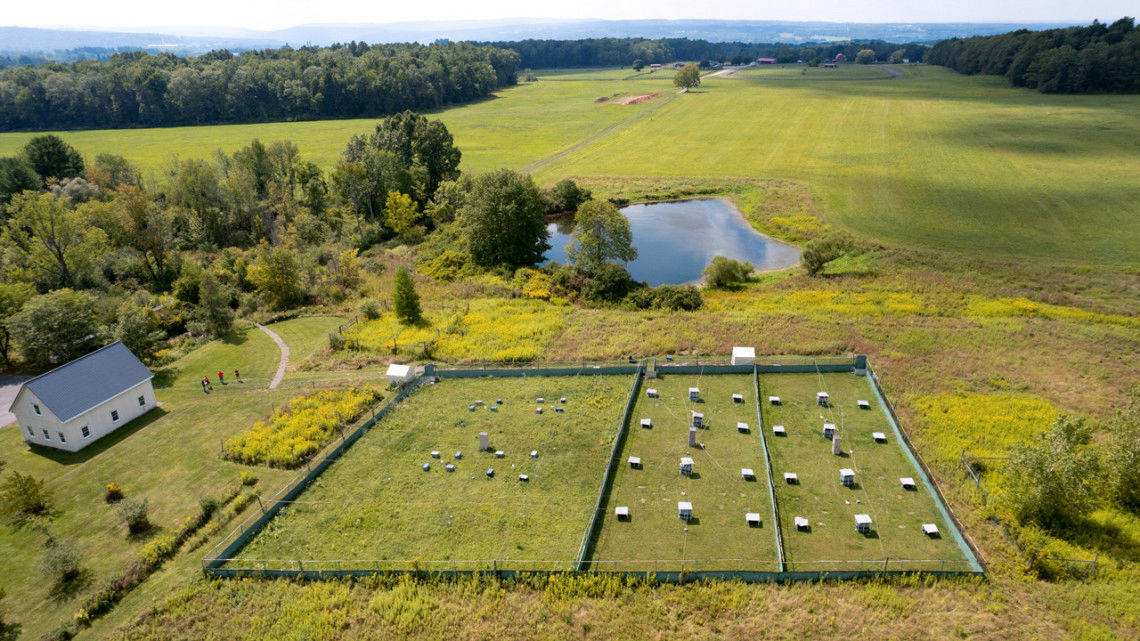
Below is the outdoor field at Cornell University where the mice were released. Previously, the mice had been living in cages slightly larger than shoeboxes, but here, for the first time, they were able to smell the outside air, go into the grass, stand on the ground, dig holes, find their own food, and sense the changing weather and seasons.
'The researchers then challenged the same mice again with the elevated plus maze one week later. The results showed that while the mice kept in the lab continued to spend a lot of time in the closed arms, the mice released into the wild either showed no fear response or only a very weak response in the exposed arms. This effect was also observed in mice kept outdoors after repeatedly being exposed to the elevated plus maze to establish their fear response.'
'After one week of outdoor care, the mice's anxiety behavior returned to baseline levels,' said
Although this experiment was conducted on mice, it is consistent with research in human psychology that shows that 'expanding experience increases autonomy and reduces anxiety.' Zipple believes that the behavioral changes in the mice are fundamentally related to 'autonomy,' and that the mice's confidence may have increased as they faced and overcame various challenges in their outdoor environment.
'When we release mice into a very large, enclosed field, they can run around and touch grass and soil for the first time in their lives,' said Sheehan. 'This is a new approach to better understand how experience shapes subsequent responses to the outside world, and we hope that what we learn from these mice can be generalized to other animals and to humans.'
The findings suggest that we may need to rethink our lab anxiety research and mouse experiments. Science Alert states, 'What we consider anxiety in lab mice is not biologically hardwired and may be easily alleviated by their environment.'
In addition, field experiments like this one raise a number of questions for future research, such as, 'How long is the outdoor exposure necessary to reverse the fear response?' and 'Does the age of the mice affect the results?'
Sheehan said that while the study doesn't directly address human behavior, it still has profound implications for humanity. 'One of the reasons for the rise in anxiety among young people is that they're living more sheltered lives. This research reflects a lot of the conversation we're having about modern society and our own lives, which is really interesting,' he said.
Related Posts: