Industry group NetChoice wins lawsuit to prevent online age verification and blocking of children's SNS

In recent years, a number of bills have been passed requiring age verification on various websites and social media platforms in the name of protecting children from the harms of the internet. The U.S. state of Louisiana also passed the 'Children's Online Safety and Age Restrictions Act (Act 456)' in 2023. However, a lawsuit filed by the industry group NetChoice resulted in an injunction blocking Act 456, ruling it unconstitutional.
NetChoice Wins Permanent Block of Louisiana Age Verification Law, Protecting Free Speech and Parental Rights - NetChoice
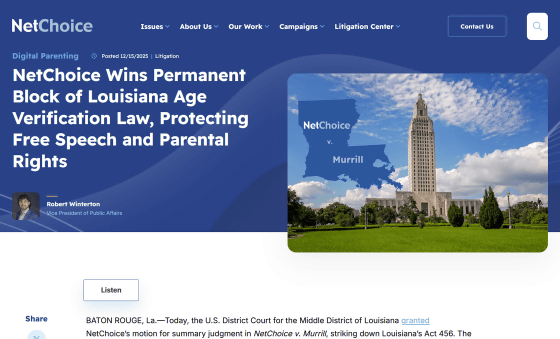
Louisiana social media law ruled unconstitutional | Courts | nola.com
https://www.nola.com/news/courts/louisiana-social-media-age-verification-unconstitutional/article_aec1f16c-aba2-41cb-83b0-9180d953e2c5.html
Louisiana's Act 456 requires social media companies to verify the age of Louisiana account holders, require parental consent for accounts held by children under the age of 16, and provide parental controls to parents.
However, NetChoice, an industry group that includes Meta, Google, Reddit, Discord, and others, filed a lawsuit in Louisiana state court alleging that Louisiana's Act 456 violates the First Amendment , which protects free speech.
Then, in December 2025, the U.S. District Court for the Middle District of Louisiana ruled in favor of NetChoice, invalidating Act 456. The ruling found that the law, which required Louisiana residents to submit sensitive government ID to access protected speech online, violated the First Amendment.
Louisiana Judge John DeGravelles argued that 'states have legitimate powers to protect children from harm, but that does not include unlimited powers to restrict the ideas to which children may be exposed,' concluding that Act 456 may be unconstitutional and does not carry the level of burden necessary to restrict freedom of expression.
'Today in Louisiana, the First Amendment won. The government does not have the power to restrict access to lawful speech it doesn't like. As the district court recognized, the First Amendment prohibits the government from requiring identification outside the door of a library. The same applies to social media,' said Paul Taske, co-director of the NetChoice Litigation Center.

In this judgment, the Court reaffirmed the following:
First Amendment Protection of Access to Information: The government cannot block adults or minors from accessing protected speech in the name of security.
Privacy is paramount: Forcing users to verify their age with government-issued ID undermines online anonymity and puts user data at risk.
Ambiguous laws are invalid: The vague definition of the “social media platforms” covered by Act 456 leaves companies guessing, leading to arbitrary enforcement of the law.
In response, Louisiana Attorney General Liz Murrill issued a statement saying, 'The problem of online predators attacking children is one that we must address with all our might. It is unfortunate that the court chose to protect a giant corporation that facilitates child exploitation rather than pursue legislative policy that requires simple age verification mechanisms.' She also announced that she intends to appeal the ruling.

Related Posts:








in Web Service, Posted by log1h_ik