What are the results of asking deeper questions about the use of AI in writing classes rather than simply banning it?
Since the emergence of ChatGPT in 2022, much debate has been sparked about the appropriateness of students using generative AI at universities and other educational institutions. Rather than banning the use of generative AI,
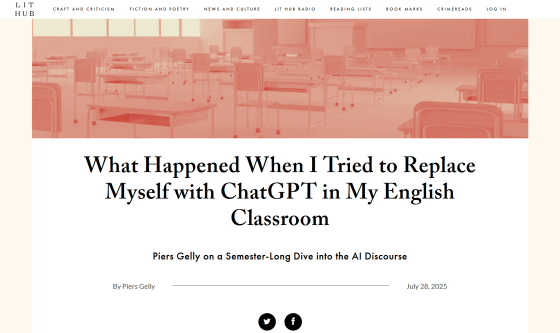
What Happened When I Tried to Replace Myself with ChatGPT in My English Classroom ‹ Literary Hub
https://lithub.com/what-happened-when-i-tried-to-replace-myself-with-chatgpt-in-my-english-classroom/
Like many teachers, Gary has been thinking about using generative AI in his classes for the past two years. While he believes that public universities like the University of Virginia have a role to play in transforming students into new writers and readers, he also understands that busy college students and the ubiquity of generative AI make good sense for outsourcing writing to generative AI.
So, in his writing class in 2024-2025, Gary adopted an approach that 'rather than banning AI outright, he asked more fundamental, existential questions about AI.' He first asked a total of 72 students whether they agreed with statements such as 'using a calculator in math class is unethical' and 'using a generative AI service in English class is unethical.' Only one student deemed the use of a calculator unethical, and only five were neutral. Meanwhile, 17 deemed the use of generative AI unethical, and 33 were neutral.
However, just because students believe generative AI is unethical does not mean they are not using it. When anonymously asked if they had used generative AI in a writing assignment for credit, many students admitted to using it. The breakdown was 'editing the first draft' (22%), 'creating an outline' (28%), 'interpreting the text' (38%), 'proofreading' (50%), and 'brainstorming' (56%). A small number of students also used AI for source research and writing the first draft.
Gary said, 'Obviously, some of these use cases may not be unethical depending on your perspective, but I was encouraged by the inconsistency in these survey responses. These students didn't seem like nihilistic, relentless cheaters, but rather, they seemed genuinely confused. I felt like I could work with these confused students on this challenge.'

Over the next few weeks, Gary had students complete a series of writing assignments with and without AI, and compared the results. Students generally expressed a dislike for AI, describing the AI's writing as 'bland' compared to human writing. They also began to notice distinctive signatures in the AI's writing, such as a tendency to falsify citations and sources, a tendency to use '—' (em dash) in ways that students would never use, and a tendency to always include three example sentences.
As the conversations about AI continued, the students formed the opinion that, while AI is not suited to producing a first draft, it could be useful in the brainstorming and editing stages before and after writing.
In the next class, students read an article from 2024 about a study on the impact of AI on creative writing. The study recruited 293 amateur writers to write short stories on a given topic, both with and without the assistance of AI, and then had 600 readers independent of the publishing industry rank the stories on style, novelty, and publishability.
The results showed that novels written with AI assistance were rated 8% higher in novelty and 9% higher in publishability, with the benefits being greatest for the poorest writers. Meanwhile, the 'creative stories' written with AI assistance were also found to be very similar to each other, even though they were individually rated as highly creative. For example, when the AI was asked to generate ideas for short stories with the theme of 'high seas adventure,' most of them revolved around the word 'treasure hunt,' and the phrase 'the real treasure is...' frequently appeared.
When writers get ideas for novels from AI, it improves creativity, but it also creates major problems - GIGAZINE

After having the students discuss this issue, Gary asked them to read aloud the 'essay titles' they had submitted that morning as an assignment. The assignment was to use AI to create a title for their midterm essay. The students used AI to create a title based on the theme Gary had given them: 'Our Relationship with Technology.'
The students felt that the titles they created with the help of AI were good, but when they actually read them out loud, they ended up with something like this:
'Surviving the Digital Age: How Technology Shapes Our Social Life, Learning, and Well-Being'
'Surviving the Digital Age: Personal Reflections on Technology'
'Surviving the Digital Age: Individual and Collective Perspectives on the Role of Technology in Our Lives'
'Navigating Connections: Exploring the Relationship Between Technology and the Individual'
From Connection to Disconnection: How Technology Shapes Our Social Lives
From Connection to Distraction: How Technology Shapes Our Social and Academic Lives
'From Connection to Distraction: Navigating Our Love-Hate Relationship with Technology'
Between Connection and Distraction: Exploring the Role of Technology in Our Lives
The students were clearly not happy with the titles they created with the AI, as they found them to be very similar. 'We rely on computers that produce the same results no matter who uses them, but in the context of writing, it's boring,' Gary said. He pointed out that AI inevitably produces similar results because of the strong influence of training data.
On the other hand, in a class where students were asked to have an AI rewrite their midterm essays, read each aloud, and decide which one was the AI-written one, the class unanimously decided that the AI-written essay was the one the students had written. This was because the AI-written essay described an encounter with an attractive girl, which reminded students of the bias that makes it easy to mistake 'romantic comedies' for reality, including Gary's.

Gary continued to deepen the students' understanding of AI through exercises such as having them compare the feedback they wrote on essays they submitted with the feedback provided by the AI, and through lectures such as how various types of academic misconduct had been a problem even before the advent of AI.
Finally, they were asked to write an essay on the question, 'Is it still worth studying writing, even with the advancement of generative AI?' 68 out of 72 students argued for the need for writing classes and human instructors like Gary. Many students argued that while they used AI frequently in the past, they will likely use it less in the future.
However, some students also expressed the view that 'generative AI is already part of the writing process,' 'students attending top universities like the University of Virginia already have a great education, so there's no need to take writing classes to improve their writing skills,' or 'the tuition and time spent on writing classes would be better spent on something more interesting. If all you're doing is writing, generative AI can help you with much less cost.' Gary also reported that some students had clearly used AI to write essays arguing for the value of writing classes.
Related Posts: