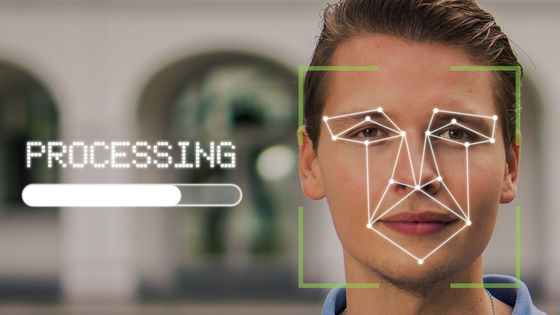
European Parliament approves world's first 'AI regulation law' by majority vote

The 'world's first AI regulation law,' which was
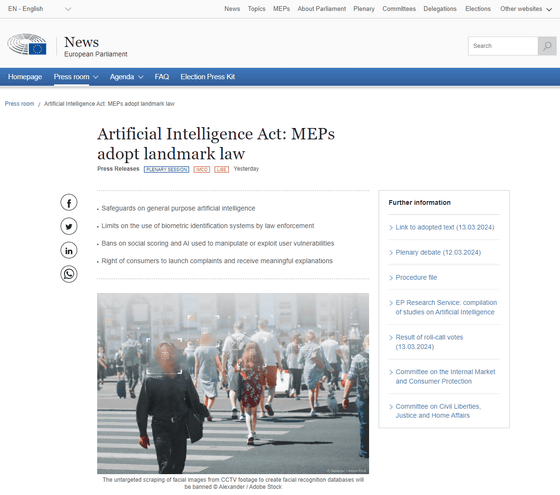
Artificial Intelligence Act: MEPs adopt landmark law | News | European Parliament
https://www.europarl.europa.eu/news/en/press-room/20240308IPR19015/artificial-intelligence-act-meps-adopt-landmark-law
World's first major act to regulate AI passed by European parliamentarians
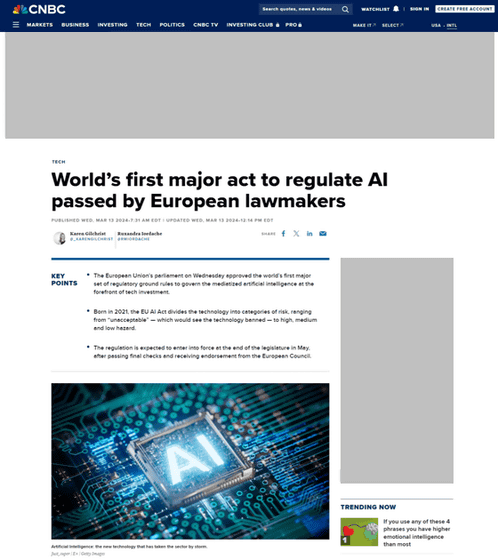
The bill was the result of extensive discussion and consideration based on a draft submitted by the European Commission in 2021, and does not seek to regulate AI itself, but rather sets out obligations regarding AI based on the potential risks and impact levels of its use in society.

European-based companies have published an open letter of protest, saying the move will have a devastating impact on Europe's competitiveness.

Below is the moment the voting results were announced.
Historic moment in #EPlenary today! ✨
— IMCO Committee Press (@EP_SingleMarket) March 13, 2024
MEPs just approved the Artificial Intelligence Act ????
Results ????️ 523➕46➖49⭕
Read our press release here shortly ???? https://t.co/hWbY5g78it pic.twitter.com/OlBmVItYyr
The 'AI Regulation Act' would ban certain AI applications that threaten civil rights, such as biometric classification systems based on minute characteristics and scraping facial images of random people from online or security camera footage to create facial recognition databases.
It will also prohibit AI that attempts to manipulate human behavior or exploit human weaknesses, such as emotional recognition in the workplace or school, social scoring, or predictive policing based solely on profiling or characterization.
The use of biometric identification systems (RBI) by law enforcement agencies will also be prohibited in principle, and real-time RBI will only be available if strict safeguards are met. Cases where it can be used include those with limited time and geographic scope and specific prior judicial or administrative authorization, such as searching for missing persons or preventing terrorist attacks. Ex post facto use of RBI will be deemed a high-risk use, requiring judicial authorization related to criminal offenses.
Other clear legal obligations will also arise for high-risk AI systems that may have significant impacts on health and safety, fundamental rights, the environment, democracy, the rule of law, etc.
General Purpose AI (GPAI) and the GPAI models on which it is based must meet certain transparency requirements, including compliance with EU copyright law and the publication of detailed summaries of the content used for training. Additionally, manipulated or artificially created images, audio, and video, so-called 'deepfakes,' must be clearly labeled as such.
Other measures include supporting start-ups and small and medium-sized enterprises by allowing them to develop innovative AI and train it before bringing it to market, through nationally controlled sandboxes and real-world testing environments.
The bill still needs formal approval by the Board before it can become law, and will take effect 20 days after it is published on the public record, with full application 24 months after it becomes effective. However, the Code of Conduct will take effect 9 months after it becomes effective, the General AI Rules including Governance will take effect 12 months after it becomes effective, and the High-Risk AI Systems Obligations will take effect 36 months after it becomes effective.
Related Posts: